
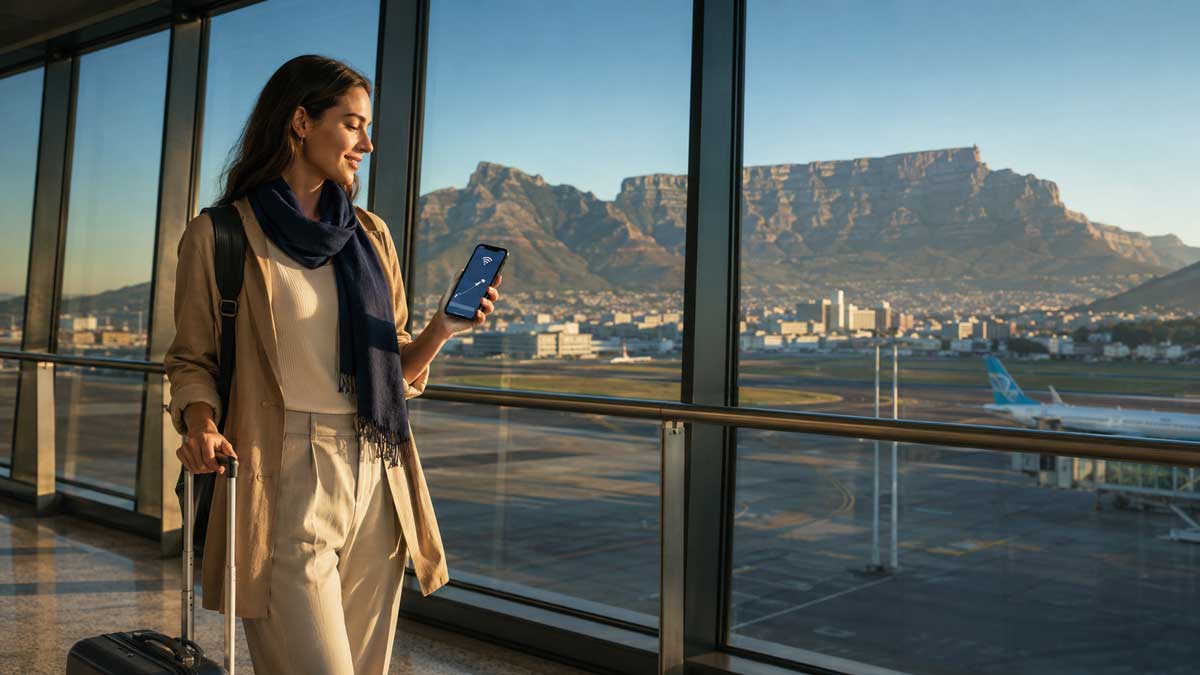
Travelling through Africa has never been more connected. A traveller can land in Cape Town, Nairobi or Dar es Salaam and within minutes use a phone to contact a transfer driver, open a hotel reservation, navigate with Google Maps, message family at home or check the next stage of an itinerary.
That connectivity has changed international travel.
It has also changed travel safety.
A mobile phone is no longer simply something travellers use to make calls. It carries boarding passes, accommodation details, maps, banking applications, travel insurance information, medical records, emergency contacts and communication tools.
Travel insurance, emergency coordination and mobile connectivity
When something goes wrong, that same device can become one of the most important pieces of emergency equipment a traveller possesses.
But Africa presents a particular connectivity challenge.
A phone that works perfectly in Johannesburg may lose signal on a remote road in Namibia. Excellent mobile coverage in Nairobi does not mean uninterrupted connectivity across the Masai Mara. A traveller may have fast mobile data in Arusha before discovering that coverage changes considerably as they travel towards the Serengeti.
The same pattern occurs across Botswana, Mozambique, Zimbabwe, Zambia, Uganda, Rwanda and the Indian Ocean islands.
Travellers therefore need to understand an important distinction.
Having an eSIM does not guarantee mobile coverage.
Having mobile coverage does not guarantee an effective emergency response.
And having travel insurance does not necessarily mean someone is immediately coordinating what happens during the first critical minutes of an emergency.
Safe travel requires these different pieces to work together.
This is the principle behind connected travel safety.
It combines reliable mobile connectivity, sensible offline preparation and access to professional emergency coordination when something goes wrong.
For travellers to Africa, understanding that relationship is becoming as important as understanding passports, visas, insurance or vaccinations before departure.
Why Mobile Connectivity Has Become Essential for African Travel
Twenty years ago, travellers routinely disappeared from communication for days while on safari.
Families expected it.
Travellers accepted it.
Hotels communicated through landlines and radio networks, printed maps were standard equipment and travel agents frequently had no contact with clients between arrival and departure.
Modern travel works very differently.
Visitors expect to remain connected almost continuously.
A couple landing at OR Tambo International Airport may use WhatsApp to contact their transfer company before using mobile data to check into their accommodation.
A family travelling through Namibia may depend on navigation applications while driving between lodges.
Safari travellers in Kenya may receive flight information through email or WhatsApp.
Visitors travelling between Tanzania and Zanzibar may need online access to ferry, airline and accommodation information.
Connectivity has become woven into the basic mechanics of travelling.
It is during an unexpected event, however, that its importance becomes most obvious.
Imagine developing severe abdominal pain at a safari lodge several hours from a major hospital.
The immediate problem is not necessarily whether treatment exists somewhere in the country.
The problem is determining what should happen next.
Does the traveller need a doctor?
Can the lodge arrange transport?
Where is the appropriate medical facility?
Does an evacuation need to be considered?
Should the insurer be contacted?
Who tells the traveller’s family?
Does the travel agent need to reorganise the itinerary?
These are coordination problems.
Communication allows them to be solved.
The faster reliable information can move between the traveller, emergency coordinators, medical professionals and other relevant parties, the faster an appropriate response can begin.
This is why connectivity should now be considered part of travel preparation rather than simply a holiday convenience.
Mobile networks provide a vital lifeline in emergencies
What Is an eSIM and Why Does It Matter in Africa?
An eSIM is a digital SIM profile that can be installed on a compatible smartphone without inserting a physical SIM card.
For international travellers, the biggest advantage is convenience.
Instead of arriving at an airport and searching for a mobile network shop, a traveller can arrange connectivity before departure.
The eSIM is installed digitally.
When the traveller arrives in the destination and connects to a supported local network, mobile data becomes available.
The traveller can generally keep their normal SIM active at the same time, depending on their device and settings. This means their home telephone number can remain available while mobile data is routed through the travel eSIM.
For African travel, this can be particularly useful because itineraries frequently cross borders.
A typical holiday might combine South Africa and Botswana.
Another might combine Kenya, Tanzania and Zanzibar.
A longer Southern African itinerary could include Namibia, Botswana, Zimbabwe and Zambia.
Buying and registering a new physical SIM every time a border is crossed adds unnecessary complexity.
A suitable regional eSIM can make the process considerably easier.
But there is an important point travellers need to understand.
Best mobile networks for travellers in Africa
An eSIM is not itself a mobile network.
The eSIM connects the traveller to one or more existing mobile network operators.
That underlying network ultimately determines where the phone receives coverage.
This distinction is frequently missing from generic eSIM comparisons.
An eSIM provider can advertise coverage in Kenya, for example, but the traveller should also understand which Kenyan network the eSIM uses and how that network performs along their actual itinerary.
The best connectivity decision is therefore not simply:
“What is the best eSIM for Africa?”
The better question is:
“Which eSIM gives me access to the strongest networks where I am actually travelling?”
That is particularly important for safari and remote travel.
Africa Does Not Have One Mobile Network
Talking about “mobile coverage in Africa” can be misleading.
Africa is enormous.
The countries covered by TravelSafe SOS alone stretch across thousands of kilometres and include some of the most geographically diverse travel environments on Earth.
South Africa has sophisticated telecommunications infrastructure across its major cities and towns, yet travellers can still encounter weaker signal in wilderness areas.
Namibia combines modern urban connectivity with enormous sparsely populated regions where road travellers may spend long periods beyond dependable terrestrial mobile coverage.
Botswana has strong connectivity around major population centres, but an Okavango Delta safari takes travellers deep into areas where permanent mobile infrastructure is neither practical nor desirable.
Kenya has extensive mobile penetration, but the experience in Nairobi is very different from connectivity deep within a wildlife conservancy.
Tanzania presents the same contrast between major centres such as Dar es Salaam and Arusha and remote areas of the safari circuit.
Mozambique’s long coastline and varied infrastructure mean network performance can change significantly between Maputo, Vilanculos, inland areas and more remote destinations.
This is why travellers should stop thinking in terms of whether a country “has coverage.”
The real issue is whether there is coverage along the individual journey.
That is a far more useful way to prepare.
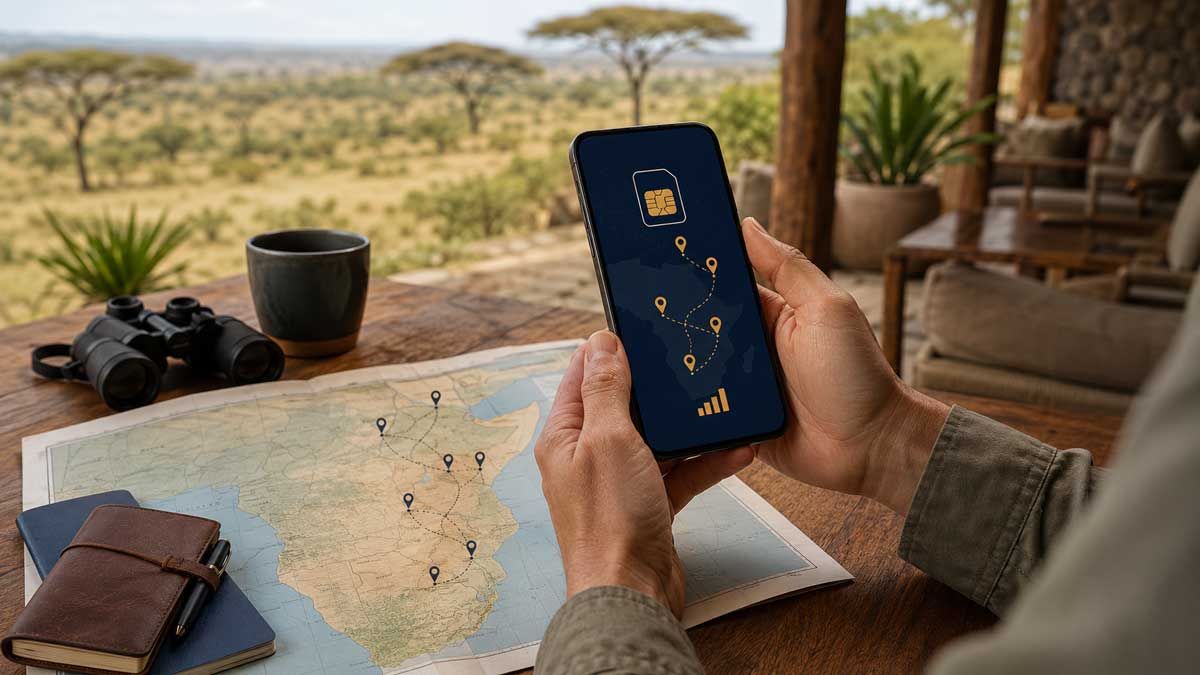
City Connectivity and Safari Connectivity Are Different
Most international visitors first experience African mobile networks at an airport or in a major city.
The experience can be excellent.
Fast data creates an understandable expectation that the same service will continue throughout the holiday.
Then the traveller leaves the city.
A safari itinerary deliberately moves away from dense urban infrastructure.
That is part of its appeal.
The Okavango Delta would not be the Okavango if every wilderness concession contained mobile towers.
The Serengeti would lose part of its character if every remote landscape offered urban levels of connectivity.
Travellers should therefore expect coverage to change.
Many safari lodges provide Wi-Fi, sometimes through satellite connections. Others intentionally restrict connectivity to communal areas. Some remote camps may provide excellent internet despite having little conventional mobile signal.
The important lesson is not that remote travel is unsafe.
It is that travellers should prepare differently.
Download important information before leaving reliable coverage.
Keep essential travel documents available offline.
Save important telephone numbers locally.
Carry adequate battery capacity.
Understand where the next reliable communication point is likely to be.
And ensure somebody knows the planned route.
Technology is enormously useful, but sensible travel preparation remains essential.
Mobile networks provide a vital lifeline in emergencies
Local SIM, International Roaming or eSIM?
Travellers now have three principal ways of maintaining mobile connectivity while travelling through Africa.
Traditional international roaming is the easiest because nothing needs to be changed on the phone.
It can also be extremely expensive.
The traveller’s home network establishes roaming agreements with foreign operators and charges according to its own international tariffs or travel packages.
For short visits or travellers whose employers cover roaming costs, this may be acceptable.
For longer holidays, costs can become substantial.
Local physical SIM cards usually provide excellent value and direct access to domestic mobile networks.
They remain a good option, particularly for travellers spending several weeks in one country.
The inconvenience comes from purchasing, registering and installing them, particularly when an itinerary crosses several borders.
Travel eSIMs offer a third option.
They allow travellers to arrange data connectivity digitally, often before leaving home, while retaining their normal SIM.
For many modern African itineraries, this provides an attractive balance between convenience and cost.
The correct choice depends on the journey.
A business traveller spending three days in Johannesburg may be perfectly happy roaming.
Someone spending a month travelling through Namibia may prefer a local SIM.
A traveller visiting Kenya, Tanzania and Zanzibar during one holiday may find a regional eSIM considerably easier.
The important point is preparation.
The worst time to begin thinking about connectivity is after something has already gone wrong.
TravelSafe SOS and the Idea of Arriving Connected
TravelSafe SOS is introducing a different approach to this problem.
Rather than treating emergency assistance and connectivity as unrelated products, the platform is bringing them together.
A TravelSafe SOS activation will include 1GB of complimentary travel eSIM data at no additional charge, subject to device compatibility and applicable destination coverage.
The existing TravelSafe SOS activation remains USD 20 for 30 days.
The purpose of including connectivity is not to transform TravelSafe SOS into another eSIM retailer.
It is to help ensure that travellers arrive with the communication capability needed to use modern travel services and access assistance when required.
The principle is simple:
Arrive Connected. Travel Protected.
A traveller can install their connectivity before departure.
After landing, they can access maps, messaging and travel information without first finding an airport SIM-card retailer or relying entirely on public Wi-Fi.
At the same time, TravelSafe SOS is already available should a medical or security emergency occur.
The eSIM provides connectivity.
TravelSafe SOS provides the professional emergency coordination behind that connectivity.
That distinction is fundamental.
Connectivity Alone Is Not an Emergency Response
The travel industry sometimes creates the impression that technology itself solves safety problems.
It does not.
A mobile phone can identify a location.
It cannot decide which medical facility is appropriate.
An eSIM can transmit data.
It cannot assess whether a traveller requires an ambulance, medical advice or evacuation.
WhatsApp can contact family.
It cannot coordinate multiple emergency responders.
Travel insurance can provide essential financial protection.
It does not automatically mean that somebody is managing the practical response during the first moments of every incident.
TravelSafe SOS exists to bridge this gap.
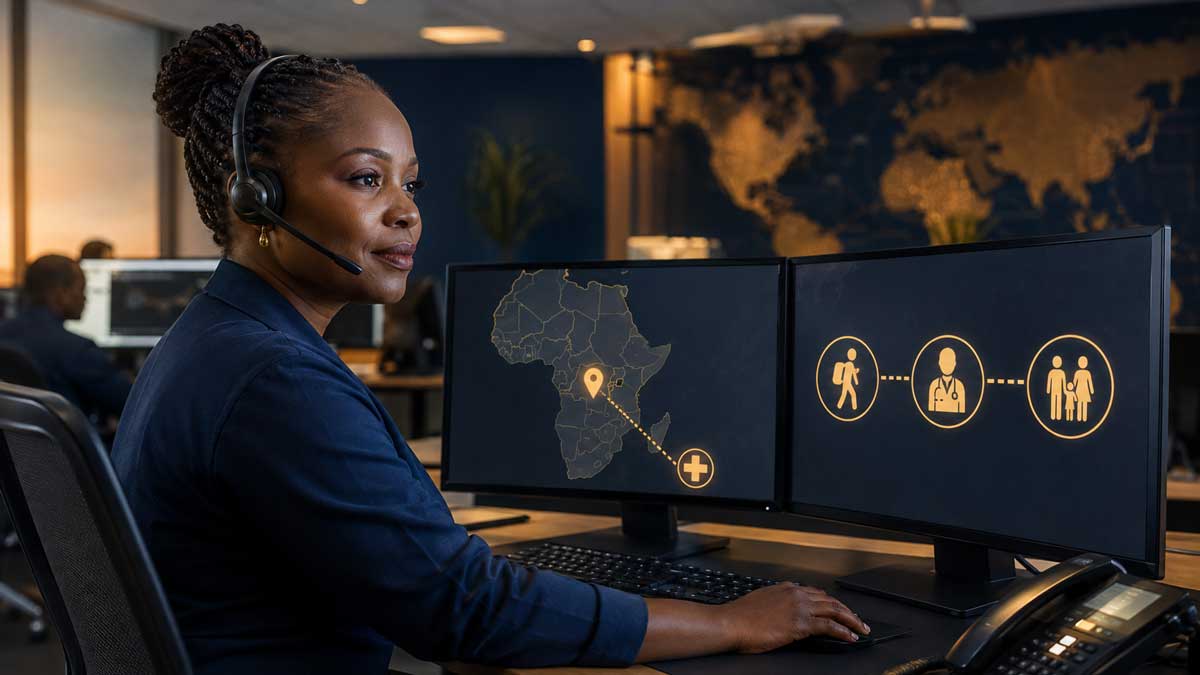
When an emergency is activated, the objective is to establish what has happened, where the traveller is located and what type of assistance is required.
The control centre can then coordinate an appropriate response and keep relevant parties informed.
Depending on the circumstances, those parties can include emergency responders, medical providers, the traveller’s insurer, travel consultant and nominated next of kin.
Connectivity makes that process easier.
Professional coordination turns connectivity into action.
That is the central difference between simply having mobile data and having a connected travel safety system.
The First Minutes Matter
Most travellers think about emergencies in terms of hospitals, ambulances or insurance.
In reality, the first challenge is often information.
Where exactly is the traveller?
What happened?
Is the situation medical or security related?
Is the traveller conscious?
Can they move?
What resources are nearby?
Which facility is appropriate?
Who needs to be informed?
Africa’s size makes these questions particularly important.
An emergency in central Cape Town is fundamentally different from an emergency on a gravel road in Namibia.
A medical incident in Nairobi is different from an injury at a remote safari camp.
The correct response depends on geography, available infrastructure and the nature of the emergency.
Being able to communicate accurate information quickly can reduce uncertainty at precisely the moment when uncertainty is most dangerous.
That is why connected travel safety should begin before departure rather than after an incident occurs.
The Complete Guide to Staying Connected and Safe While Travelling in Africa
What Happens When Mobile Signal Disappears?
One of the most important principles of connected travel safety is understanding that connectivity cannot be guaranteed.
This is particularly important in Africa.
Travellers may spend most of a holiday with excellent mobile service and then enter a national park, mountain region, remote coastal area or sparsely populated road where coverage becomes intermittent or disappears completely.
An eSIM does not change this reality.
Neither does a physical SIM card.
Both ultimately depend on available telecommunications infrastructure and the local network to which the device connects.
This needs to be understood before travelling rather than discovered during an emergency.
Travellers heading into remote areas should download maps for offline use, store accommodation and emergency details on their device, ensure important documents can be accessed without internet connectivity and carry sufficient battery capacity for the planned journey.
Someone should also know where they are going.
For self-drive travellers, that may mean sharing the day’s intended route with accommodation or family. On safari, the lodge or guide normally provides an additional communication layer because professional safari operations often maintain radio, satellite or other communications independent of the traveller’s mobile phone.
The purpose of TravelSafe SOS is not to pretend these dead zones do not exist.
It is to make travellers better prepared for them and provide professional emergency coordination whenever communication is available.
If connectivity disappears temporarily, preparation matters.
When connectivity returns, the ability to communicate quickly becomes important again.
This distinction is particularly relevant for travellers choosing an eSIM. The question should never simply be whether a package “covers” a country. Travellers need to understand that national availability and uninterrupted geographical coverage are completely different things.
Why Remote Africa Requires Different Connectivity Thinking
Some of Africa’s most rewarding destinations are rewarding precisely because they are remote.
A tented camp in the Okavango Delta does not operate within the same telecommunications environment as central Johannesburg.
A lodge in Namibia’s Damaraland should not be judged by the same connectivity expectations as a Cape Town hotel.
A mobile phone used beside a swimming pool in Zanzibar may perform very differently during an excursion away from established tourism areas.
This does not make these destinations inherently unsafe.
It means travellers should understand the infrastructure surrounding their journey.
Good safari operators, lodges and professional travel companies have been managing remote communications for decades. Radios, satellite systems, lodge networks, aviation companies and local operational contacts frequently provide additional communication channels.
The modern traveller adds another layer through their smartphone.
TravelSafe SOS adds another layer beyond that through professional emergency coordination.
These systems complement rather than replace one another.
That is the sensible way to approach remote African travel.
Staying Connected Across Southern Africa
Southern Africa illustrates why a single answer to the question “Will my phone work in Africa?” is impossible.
South Africa has extensive mobile infrastructure and generally strong connectivity across major tourism centres, including Cape Town, Johannesburg and the principal towns along established travel routes. Even here, however, mountainous areas, wilderness reserves and sections of national parks can produce weaker signal.
Kruger National Park is a good example. Visitors should not assume that the quality of connectivity experienced near a major rest camp will continue throughout every game-drive route. The park covers an enormous wilderness area, and signal strength changes as travellers move through it.
Namibia presents an even stronger contrast.
Windhoek and the main coastal centres are well connected, but self-drive travellers often deliberately head into sparsely populated landscapes. Long stretches of Damaraland, Kunene and other remote regions require a different level of preparation.
Botswana creates another variation. Maun and Kasane are important tourism centres with conventional mobile services, but an Okavango safari may involve light-aircraft transfers into remote concessions where the traveller’s phone is no longer the primary communication system.
Zimbabwe and Zambia have good connectivity around major urban and tourism centres, while remote safari areas naturally present more variable conditions.
Mozambique is particularly important because network performance can differ considerably according to region. Connectivity in Maputo cannot be used to predict the experience in a remote coastal or inland destination.
For travellers crossing several of these countries, the attraction of regional eSIM connectivity becomes obvious. It can remove the repeated inconvenience of purchasing and registering physical SIM cards at each border.
It does not remove the need to understand the route.
Staying Connected Across East Africa
East Africa presents perhaps an even stronger case for regional connectivity because international travellers frequently combine several destinations within one itinerary.
A classic journey might begin in Nairobi, continue into a Kenyan safari area, cross into Tanzania for the Serengeti and Ngorongoro, and finish on Zanzibar.
The traveller has moved between major cities, rural regions, national parks and an island environment during a single holiday.
Mobile performance changes throughout that journey.
Nairobi and Dar es Salaam offer the type of connectivity international travellers increasingly expect from major cities.
Safari changes the equation.
The Masai Mara, Amboseli, Serengeti and other wilderness areas contain locations where mobile service is available and others where it becomes weak or absent.
Lodges may provide Wi-Fi through terrestrial or satellite systems even where conventional mobile reception is limited.
Zanzibar presents another environment again, with generally good connectivity across established tourism areas but local variations according to network, location and infrastructure.
Uganda and Rwanda similarly combine increasingly sophisticated mobile environments with mountainous and rural tourism areas where travellers should not assume uninterrupted coverage.
This is why the forthcoming TravelSafe SOS country connectivity guides will examine the underlying mobile networks and actual traveller routes rather than simply comparing eSIM prices.
A traveller does not need the cheapest gigabyte available.
They need appropriate connectivity for the journey they are actually taking.

Why One Gigabyte Is More Useful Than It Sounds
TravelSafe SOS plans to include 1GB of complimentary travel data within its standard 30-day activation, subject to device compatibility, destination coverage and the final eSIM implementation.
One gigabyte is not designed to provide unlimited holiday entertainment.
That is precisely why the proposition should not be marketed as a large free-data giveaway.
Used sensibly, 1GB provides valuable arrival and travel connectivity.
Messaging generally consumes relatively little data.
Email, basic web browsing and travel applications can also be relatively economical.
Maps can be used efficiently, particularly when offline mapping has been downloaded in advance.
The complimentary allocation therefore provides the traveller with something immediately useful from the moment they arrive.
Someone landing in Johannesburg can contact their transfer.
A traveller arriving at Nairobi’s airport can message their safari company.
A visitor arriving in Tanzania can access accommodation information without searching for public Wi-Fi.
The traveller is not beginning the journey disconnected.
For heavier data users, additional data can eventually be purchased through suitable top-up options as the TravelSafe SOS connectivity service develops.
The important principle remains unchanged.
The complimentary allowance is there to help the traveller arrive connected.
The Difference Between Connectivity, Insurance and Emergency Assistance
These three services are sometimes confused, but they solve fundamentally different problems.
An eSIM provides mobile connectivity.
Travel insurance provides financial protection against covered events according to the terms of the policy.
TravelSafe SOS provides access to professional emergency coordination.
A traveller may need all three.
Consider a medical incident during a safari.
The eSIM may provide the connectivity required to communicate.
TravelSafe SOS can help assess the situation and coordinate the appropriate response.
The insurer may become involved in authorising or reimbursing covered medical treatment, evacuation or other expenses according to the policy.
None of these functions makes the others unnecessary.
They complement one another.
This distinction is particularly important because travellers sometimes assume that purchasing insurance means every practical aspect of an emergency will automatically be managed from the first moment.
Insurance is essential, but its primary purpose is financial protection.
TravelSafe SOS has been designed around the immediate practical problem:
Something has happened. What do we do now?
That is where professional emergency coordination becomes valuable.
What Happens When TravelSafe SOS Is Activated?
In an emergency, travellers rarely need more information.
They need action.
When a TravelSafe SOS emergency is activated, the control centre can establish the nature of the incident and assess what type of assistance is required.
Location information helps establish where the traveller is.
The circumstances determine what happens next.
A medical problem may require medical advice, a local healthcare provider, an ambulance or escalation towards evacuation.
A security incident requires a different response.
A road accident creates another set of priorities.
The important point is that the traveller is not expected to work through the emergency system alone.
TravelSafe SOS coordinates the response according to the situation.
Relevant parties can also be informed.
That can include the traveller’s nominated next of kin, travel consultant or tour operator and travel insurer.
This communication is more important than it may initially appear.
Families thousands of kilometres away can otherwise receive incomplete or frightening information.
Travel agents may need to reorganise flights, transfers or accommodation.
Insurers may require details of medical treatment or evacuation.
Managing these communications while simultaneously dealing with an emergency places enormous pressure on the traveller and anyone accompanying them.
The TravelSafe SOS model is designed to reduce that burden.
Why Location Matters During an Emergency
In a familiar city, explaining where an emergency has happened may be relatively easy.
In unfamiliar territory, it can be surprisingly difficult.
A traveller may not know the road name.
A safari guest may only know the name of the lodge.
Someone involved in a self-drive accident may be somewhere between two towns without knowing the nearest settlement.
A beach traveller may recognise the resort but not the surrounding geography.
Digital location information can dramatically improve the quality of information available to emergency coordinators.
It does not solve the emergency by itself.
It helps answer the first essential question:
Where are you?
Once that is established, the response can be considered in geographical context.
Which resources are nearby?
What medical facilities are realistically accessible?
Is road transport appropriate?
Does the accommodation have resources that can assist immediately?
Does the situation potentially require escalation?
Accurate location is therefore one of the bridges between digital connectivity and physical emergency response.
Why Your Insurer, Travel Agent and Family Need to Know
An international travel emergency rarely affects only the traveller.
Consider what happens after a serious incident.
Family wants information.
The travel consultant may need to alter the itinerary.
Accommodation may need to be extended or cancelled.
Flights might need changing.
The insurer may require documentation.
Medical providers may need payment guarantees or policy details.
If the traveller is incapacitated, somebody else may suddenly need to manage all of this.
TravelSafe SOS recognises that emergency response is therefore partly about communication.
Alerting the relevant people quickly reduces uncertainty.
The traveller’s next of kin knows that the incident is being managed.
The travel consultant can begin addressing the practical consequences.
The insurer can be brought into the process where required.
This is one of the reasons connectivity matters so much.
An emergency is not a single telephone call.
It can become a chain of communications involving people across several countries.
Connected Does Not Mean Invulnerable
TravelSafe SOS should be particularly clear about this.
No application can remove travel risk.
No eSIM can guarantee coverage everywhere.
No mobile network can eliminate remote-area dead zones.
No insurance policy covers every possible event.
And no emergency service can promise identical response times across an area as geographically enormous as Southern and East Africa.
Responsible travel safety communication should acknowledge these limitations.
The purpose of connected travel safety is to reduce unnecessary vulnerability.
Prepare properly.
Understand where connectivity may be limited.
Carry appropriate backup power.
Keep critical information available offline.
Use reputable travel providers.
Have adequate travel insurance.
Know how to obtain assistance.
And establish an emergency support system before the journey begins.
Technology becomes powerful when it forms part of that preparation.
A Better Way to Prepare Before Travelling to Africa
The best time to prepare for an emergency is when nothing is wrong.
Before departure, travellers should understand how they intend to remain connected throughout their itinerary.
That means checking whether their phone supports eSIM, considering whether international roaming is financially sensible and understanding which mobile networks operate in the destinations they will visit.
For remote journeys, offline preparation becomes equally important.
Maps should be downloaded.
Important contacts should be stored on the device rather than left exclusively in cloud services.
Travel insurance details should be accessible.
Accommodation information should be available without an internet connection.
A power bank can be particularly useful during long road journeys and transfers.
Travellers should also tell family or another trusted person where they are going, especially when self-driving through remote areas.
None of these measures is complicated.
Together they create resilience.
TravelSafe SOS adds professional emergency coordination to that preparation.
The objective is not to make travellers anxious about Africa.
It is the opposite.
Preparation allows people to explore with greater confidence because the obvious vulnerabilities have already been considered.
Connected Travel Safety Across the TravelSafe SOS Region
TravelSafe SOS operates across a broad Southern and East African travel region including South Africa, Namibia, Eswatini, Lesotho, Botswana, Zimbabwe, Mozambique, Mauritius, Madagascar, Seychelles, Tanzania, Kenya, Rwanda, Uganda, Zambia and Zanzibar.
The connectivity experience across these destinations is not uniform.
That is why this pillar guide is only the beginning.
The TravelSafe SOS Connected Travel Safety series will examine the best mobile networks in Southern Africa and East Africa, country-specific eSIM and network choices, safari connectivity, remote self-drive preparation and what travellers should realistically expect in destinations such as Kruger National Park, the Serengeti, Okavango Delta, Zanzibar and Namibia.
The purpose is to provide something more useful than another eSIM price comparison.
Travellers need to know what works where they are actually going.
They also need to understand what happens when it does not.
That combination of connectivity information and emergency preparation is the foundation of the TravelSafe SOS approach.
Arrive Connected. Travel Protected.
Africa should not be reduced to a collection of risks.
It is one of the world’s great travel regions, offering extraordinary wildlife, landscapes, cities, coastlines and cultures.
Millions of journeys take place safely and successfully.
The objective of travel preparation is not to remove adventure from those journeys.
It is to remove avoidable uncertainty.
Mobile connectivity has become part of that preparation.
eSIM technology makes arranging that connectivity increasingly simple.
But connectivity becomes substantially more valuable when travellers also know who will help if something goes wrong.
That is the proposition TravelSafe SOS brings together.
A complimentary 1GB travel eSIM helps the traveller arrive connected.
The TravelSafe SOS control centre provides professional emergency coordination if assistance is needed.
The traveller’s insurer, travel consultant and nominated next of kin can be kept informed.
One system connects the digital journey with the real-world response.
Arrive Connected. Travel Protected.