

Imagine waking during the night at a safari lodge with severe abdominal pain.
You are several hours from the nearest major city. You have comprehensive travel insurance. Your phone has mobile data. You know that your insurance policy includes emergency medical cover.
You have prepared properly.
Staying connected and safe while travelling in Africa
But you still have an immediate problem.
What should happen now?
Your insurance policy provides essential financial protection according to its terms and conditions. Your mobile connection allows you to communicate. The lodge may have established emergency procedures and local knowledge.
But somebody still needs to assess what is happening and determine what practical response is appropriate.
Do you need a doctor?
Should you be transported to a clinic?
Is the nearest clinic capable of treating the problem?
Does the situation require an ambulance?
At what point should the insurer become involved?
If your condition is serious, could medical evacuation eventually be necessary?
These are not questions most travellers are equipped to answer while sick, injured or frightened in an unfamiliar country.
This is why travel insurance, mobile connectivity and travel emergency assistance should not be treated as competing products.
Get an eSIM before travelling to Africa
They solve different parts of the same problem.
For travellers visiting Southern and East Africa, understanding those differences can make emergency preparation considerably more effective.
What Travel Insurance Is Designed to Do
Travel insurance should be one of the foundations of responsible international travel.
A comprehensive policy can provide financial protection against potentially substantial costs associated with unexpected events. Depending on the policy purchased, this may include overseas medical treatment, hospitalisation, cancellation, interruption, lost luggage, delays, personal liability and emergency medical evacuation.
Those benefits can be enormously important.
A serious overseas medical event can become financially devastating without appropriate insurance. Even relatively straightforward treatment can be expensive, while specialist care, hospital admission or medical evacuation can involve very substantial costs.
TravelSafe SOS therefore does not replace travel insurance and should never be presented as an alternative to it.
Travellers should purchase appropriate cover for their journey and understand the policy before departure.
The words appropriate cover matter.
Travel insurance policies are not identical. Limits, exclusions, excesses, geographical restrictions, pre-existing medical conditions, adventure activities and evacuation provisions can differ significantly.
Safari travellers should pay particular attention to the destinations and activities included in their itinerary. Someone taking a conventional lodge-based safari has different requirements from a traveller climbing Kilimanjaro, diving in Mozambique or participating in another higher-risk activity.
The purpose of insurance is financial protection against covered events.
That is one layer of the traveller’s safety plan.
Travel Insurance Can Include Assistance, But Policies Differ
It would be inaccurate to suggest that travel insurers simply pay bills after an emergency has happened.
Many established travel insurers operate sophisticated 24-hour assistance services. Depending on the company and policy, these can provide medical advice, help locate treatment, liaise with hospitals, manage claims and coordinate or authorise evacuation.
This is why travellers should know what their own insurer provides rather than rely on broad assumptions about “travel insurance.”
The challenge is that insurance products vary enormously.
The telephone number, procedure, assistance provider and authorisation requirements can differ between policies. Travellers may also be expected to contact their insurer or assistance company promptly when significant medical costs are likely to arise.
That system can work extremely well.
But the traveller still needs to know how to activate it.
This becomes particularly relevant during African travel because the emergency environment can change dramatically within the same itinerary.
Someone becoming ill in Cape Town may be close to excellent private medical facilities. A few days later, the same traveller could be at a safari lodge several hours from a comparable hospital.
The insurance policy may be unchanged.
The practical response problem is completely different.
What an eSIM Is Designed to Do
An eSIM solves another part of the problem.
It provides connectivity.
How an eSIM can make travel in Africa safer
On a compatible device, an eSIM allows a digital mobile plan to be installed without replacing the phone’s physical SIM card. A travel eSIM can often be arranged before departure and may connect to partner networks across one or several countries.
For an international traveller, this can remove considerable inconvenience.
Instead of landing and immediately searching for a mobile shop, the traveller can potentially arrive with mobile data already configured. On a multi-country journey, a suitable regional plan can also reduce the need to purchase a new physical SIM whenever another border is crossed.
That connectivity supports almost every part of modern travel.
Maps, messaging, email, accommodation information, ride-hailing services, airline applications and online travel documents all depend on it.
During an emergency, connectivity becomes more important because it may allow the traveller to communicate what has happened and share their location.
But an eSIM has a very specific job.
It connects the phone to a supported mobile network.
It does not provide medical treatment.
It does not determine which hospital is appropriate.
It does not send an ambulance.
It does not assess a security threat.
It does not contact an insurer and explain what has happened.
And where no supported terrestrial mobile network exists, an ordinary eSIM cannot create coverage.
Best mobile networks for travellers in Africa
Connectivity is essential.
Connectivity is not emergency coordination.
What a Travel Safety App Adds
A travel safety service addresses the gap between establishing communication and knowing what should happen next.
TravelSafe SOS is designed around that moment.
When a traveller activates an emergency alert, the objective is to establish where they are, understand what has happened and assess the nature of the assistance required.
The response will depend on the incident.
A traveller experiencing a serious medical problem may require medical assistance and referral to an appropriate facility. Someone facing a security concern requires a different response. A road accident can involve medical, security and logistical issues simultaneously.
This is where the human element becomes important.
Technology can transmit the alert and location information.
People still need to interpret what that information means.
TravelSafe SOS operates as an Africa-focused emergency coordination layer, helping connect the traveller with appropriate available resources while keeping other relevant parties informed where required.
It complements the traveller’s insurance rather than replacing it.
And it can use mobile connectivity without pretending that connectivity itself constitutes a rescue service.
The Three Layers of Connected Travel Safety
The simplest way to understand the relationship is to think of traveller protection as three connected layers.
The eSIM provides the connection. TravelSafe SOS provides emergency coordination. Travel insurance provides financial protection according to the policy.
Each solves a different problem.
Suppose a traveller is involved in a road accident while self-driving through Southern Africa.
The mobile connection may allow the traveller to send an alert and share a GPS position.
TravelSafe SOS can establish what has happened and begin coordinating an appropriate response based on the location and circumstances.
If medical treatment, hospitalisation or evacuation becomes necessary, the traveller’s insurance may provide financial cover and assistance according to the terms of the policy. The insurer may need to authorise particular expenses or become directly involved as the situation develops.
None of those layers makes the other unnecessary.
In fact, they become more valuable when they work together.
This is the central idea travellers should understand before leaving home.
The question should not be:
Should I buy travel insurance, an eSIM or a travel safety service?
For many African journeys, the better question is:
Have I prepared for connectivity, emergency response and financial protection?
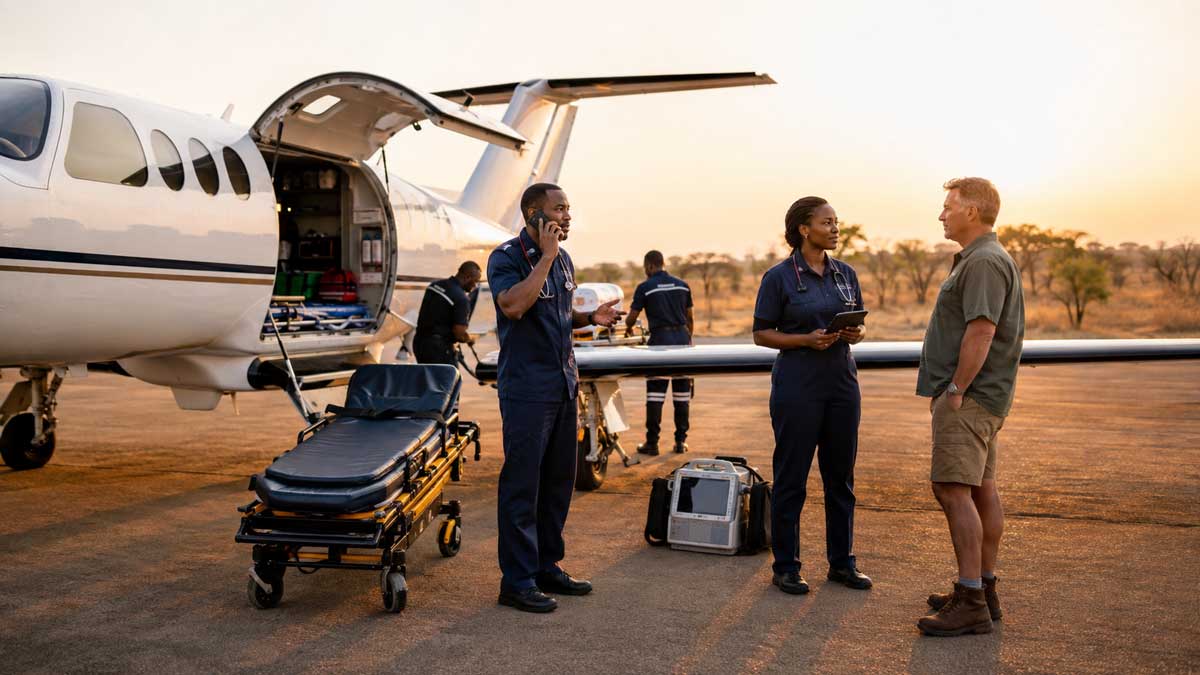
A Medical Emergency on Safari Shows How the Layers Work Together
Consider a traveller in the Okavango Delta who begins experiencing symptoms that may require urgent medical attention.
The safari lodge is an important first responder. Its staff know the local environment, available communications and logistical options. In remote safari regions, lodge teams often have established procedures precisely because conventional urban emergency infrastructure may be far away.
If cellular connectivity is available, the traveller also has a direct communications route.
TravelSafe SOS can be contacted, the circumstances assessed and appropriate assistance considered in conjunction with the resources available locally.
If the traveller requires significant treatment or evacuation, their insurer becomes an essential part of the process because policy coverage and authorisation may affect the financial arrangements and subsequent medical decisions.
The eSIM has helped create connectivity.
The emergency service helps coordinate what happens next.
The insurer provides the financial protection and assistance available under the policy.
Now imagine the same medical symptoms occur three days later in Johannesburg.
The insurance may be identical.
The phone may be identical.
The TravelSafe SOS service is identical.
But the response environment is completely different because sophisticated medical facilities may be nearby.
That is why African travel emergencies cannot be reduced to a single telephone number or generic instruction.
The response needs to reflect where the traveller actually is.
Travel Insurance Does Not Make Connectivity Unnecessary
This point is particularly important as more travellers purchase international eSIMs.
A comprehensive insurance policy may provide excellent assistance benefits, but the traveller still needs a practical way to establish contact.
Hotel and lodge Wi-Fi can help, but it should not automatically be treated as the traveller’s only communication plan.
A mobile data connection gives the traveller greater independence. Where network coverage exists, it can allow them to communicate while travelling between destinations, share a location from a roadside incident or access information away from their accommodation.
This is one reason eSIM technology is becoming relevant to travel safety.
The value is not simply cheaper internet.
It is the ability to arrive with connectivity already considered.
TravelSafe SOS plans to take that relationship further by including 1GB of eSIM travel data with its standard USD 20, 30-day activation at no additional charge, subject to final product conditions, compatible devices and supported destinations.
That does not turn an eSIM into an emergency service.
It makes it easier for the traveller to access one.
Connectivity, Coordination and Cover
There is a tendency in travel technology to search for one product that supposedly solves everything.
Travel does not work that way.
A good insurance policy is valuable because significant financial risk exists when travelling internationally.
Reliable mobile connectivity is valuable because modern travellers depend on their phones throughout the journey.
Emergency coordination is valuable because when something goes wrong, somebody still needs to help turn the traveller’s request for assistance into an appropriate response.
The strongest travel safety plan does not ask which of those services can replace the others.
It recognises that they perform different jobs.
For African travel in particular, where one itinerary can move from a sophisticated city to an isolated wilderness area within a matter of hours, that distinction matters.
Connectivity gets you online.
Emergency coordination helps you act.
Insurance helps protect you financially.
Together, they create a considerably stronger foundation for travelling with confidence.
Travel Insurance vs Travel Safety App vs eSIM: What Do You Need for Africa?
Medical Evacuation: Who Actually Does What?
Medical evacuation is one of the areas where travellers often assume one organisation controls the entire process.
In reality, several parties may become involved.
A treating doctor or medical provider may determine that a traveller requires a higher level of care than is available locally. The traveller’s insurer may need to assess coverage, authorise costs or coordinate with an assistance provider. An evacuation company may physically transport the patient by road or air. A travel consultant may need to change flights and accommodation, while family members require accurate information.
TravelSafe SOS does not replace any of these parties.
Its role is to help coordinate the practical emergency response and connect the traveller with appropriate assistance as the situation develops.
This matters because the traveller should not have to understand the structure of medical evacuation before asking for help. They need a system that can begin with the immediate problem and then involve the right organisations as necessary.
The process can be very different depending on location. A traveller in Johannesburg may have access to advanced private healthcare close by, while a serious medical incident in a remote safari region can require several stages of assessment and transport before specialist care is reached.
That is why the value lies in coordination rather than simply having a list of emergency numbers.
Security Incidents Need a Different Type of Response
Travel safety is not exclusively medical.
A traveller may experience theft, robbery, threatening behaviour or another situation where they feel unsafe. A self-drive breakdown in an isolated area can also become a security concern even when nobody is injured.
Travel insurance may eventually become relevant if there is a covered financial loss, but the immediate question is different.
What should the traveller do now?
Should they remain where they are?
Should they move somewhere safer?
What local security resources are available?
Does the incident require police involvement or another response?
An eSIM can provide the communication channel where supported network coverage exists. It cannot assess the threat.
TravelSafe SOS can help establish the nature of the incident and coordinate an appropriate response based on the traveller’s location and circumstances.
This is another reason the three-layer model is useful. The connectivity layer enables contact, the emergency-assistance layer helps determine what to do, and the insurance layer becomes relevant according to the eventual claim or covered costs.
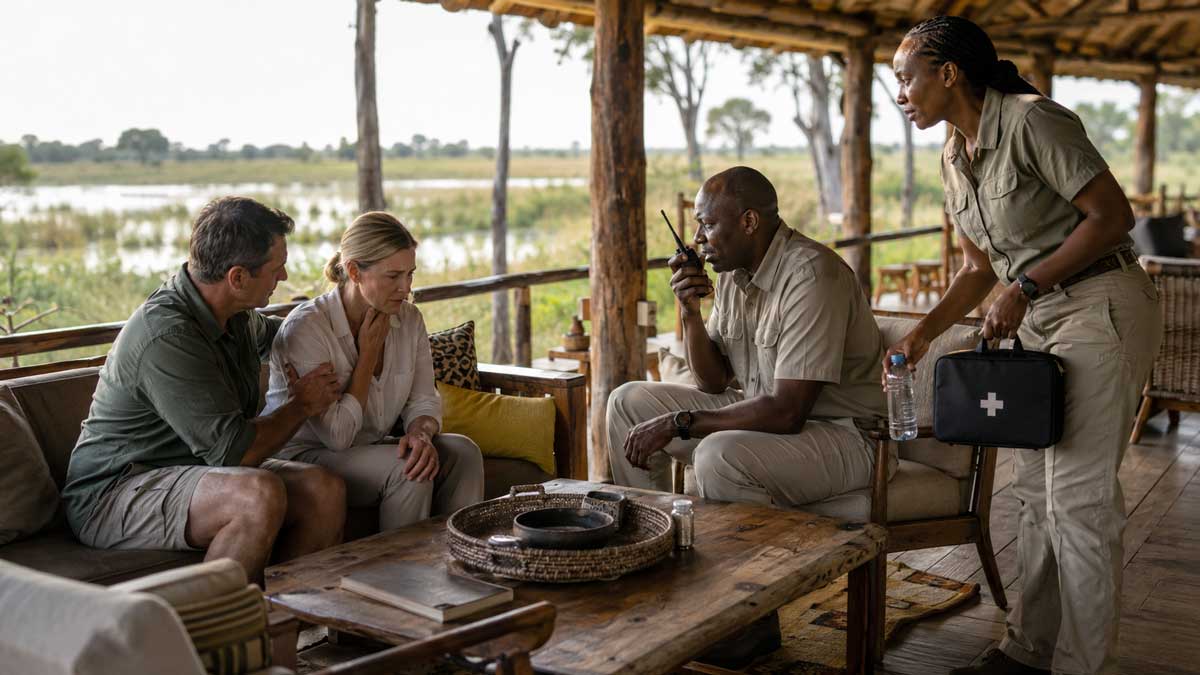
Why Your Travel Insurer Should Be Part of the Communication Chain
During a serious medical incident, insurers may need accurate information quickly.
The treating facility may require policy details. Significant medical expenses can require authorisation. An evacuation provider may need confirmation before mobilisation. The insurer may also want clinical information from the medical team involved.
Travellers are frequently in no position to manage these communications efficiently.
Someone who is ill, injured or caring for a travelling companion should not have to spend hours acting as the information bridge between medical providers, insurers and the rest of the journey.
Where appropriate, TravelSafe SOS can help ensure that the insurer is brought into the process and receives the information needed to perform its role.
This does not change the insurer’s responsibility or policy terms.
It helps the emergency move from one organisation to another without leaving the traveller to coordinate every step independently.
Why Your Travel Agent or Tour Operator Matters Too
Travel consultants often become surprisingly important once the immediate emergency starts affecting the itinerary.
A traveller who misses a charter flight may lose a safari transfer. A hospital admission can require an extra hotel night for a partner or family member. A multi-country journey may need restructuring if the traveller cannot continue as planned.
The travel professional who arranged the trip already understands the itinerary, bookings and suppliers involved.
That knowledge can save considerable time.
Instead of the traveller trying to explain every reservation from a hospital room, the consultant can start contacting lodges, airlines and transfer companies directly.
This is particularly valuable in Africa because many journeys involve complex logistics. Light-aircraft flights, boat transfers, remote camps and cross-border arrangements are common.
TravelSafe SOS can help keep the nominated travel professional informed so the practical consequences of the incident can begin being managed while emergency responders focus on the immediate problem.
Keeping Next of Kin Informed
Family members often experience an overseas emergency from thousands of kilometres away.
Their greatest difficulty is uncertainty.
They may know something has happened without knowing how serious it is. They may receive one short message and then hear nothing while the traveller is being moved or treated.
This can create enormous anxiety.
TravelSafe SOS allows nominated next of kin to form part of the communication chain where appropriate. The objective is not to provide constant commentary on the incident, but to reduce the chance that family members are left completely outside the process.
This also reduces the burden on the traveller and their companions.
Instead of repeatedly making calls home while dealing with medical or security issues, they can focus on the situation itself.
What Happens If There Is No Mobile Signal?
The three-layer travel safety model still has limitations.
An eSIM needs access to a supported mobile network. A local physical SIM does too. International roaming is equally dependent on terrestrial infrastructure.
There are places across Southern and East Africa where conventional cellular signal may be weak or unavailable.
Remote safari areas, desert roads, mountain regions and isolated coastal destinations all present examples.
This does not make the travel safety system irrelevant.
It means preparation needs several layers.
Professional safari lodges may use radio or satellite communications. Guides may have established emergency procedures. Self-drive travellers should download maps and essential information before entering remote areas and make sure somebody knows their route.
The eSIM provides connectivity where network infrastructure exists.
It should never be presented as a substitute for preparation in areas where it does not.
Does Every Traveller Need All Three?
Not every journey is identical, but for many international travellers the answer is effectively yes.
Travel insurance protects against financial risk.
Mobile connectivity allows the traveller to communicate.
An emergency assistance service provides a practical response layer.
A traveller might reasonably decide to use international roaming instead of an eSIM, or buy a local SIM after arrival. The connectivity technology itself can vary.
What should not vary is the underlying preparation.
The traveller needs a way to communicate.
They need appropriate insurance.
And they need to understand what they will do if something goes wrong.
For many African itineraries, particularly those involving safari, remote regions or several countries, having all three layers in place creates a much stronger safety structure.

Why the Included 1GB Changes the TravelSafe SOS Proposition
TravelSafe SOS currently provides a 30-day emergency assistance activation for USD 20.
The planned addition of 1GB of complimentary eSIM travel data at no additional charge changes the value of that service significantly.
The traveller is no longer paying only for an emergency service they hope never to use.
They receive an immediate, practical benefit from the beginning of the journey.
The included data can support messaging, maps, travel information, email and other ordinary mobile functions, subject to usage, compatibility and network availability.
At the same time, the emergency assistance layer remains available if something goes wrong.
This creates a much more complete proposition.
The traveller is connected.
The traveller has a response plan.
And the traveller should still have appropriate travel insurance for financial protection.
That combination is difficult to compare directly with a standalone eSIM or standalone safety app because it solves more than one part of the travel problem.
What Should You Arrange Before You Fly?
The most important decisions should be made before the journey begins.
Travellers should confirm that their insurance is appropriate for the destinations and activities included in the itinerary. They should understand how to contact the insurer or assistance provider in an emergency and keep the policy information accessible.
eSIM vs local SIM vs international roaming in Africa
Connectivity should also be arranged in advance. This may mean enabling international roaming, purchasing a local SIM after arrival or installing an eSIM before departure.
If using TravelSafe SOS, the traveller should complete the emergency profile, nominated contact information and any relevant travel details before leaving home.
Remote travellers should also understand what additional communication methods are available through lodges, guides or tour operators when conventional mobile signal disappears.
Good preparation removes decisions from the moment when people are least able to make them calmly.
The Three-Layer Model in One Sentence
An eSIM helps you connect.
TravelSafe SOS helps coordinate the response.
Travel insurance helps protect you financially.
Those functions overlap in places, but they are not interchangeable.
For travellers to Africa, understanding the difference creates a stronger and more realistic safety plan.
Arrive Connected. Travel Protected.
Travel safety should not be built around fear.
The overwhelming majority of travellers visit Africa without experiencing a serious emergency.
The purpose of preparation is not to make the traveller think constantly about what might go wrong.
It is to remove uncertainty before the journey begins.
Appropriate travel insurance gives financial reassurance.
Reliable connectivity provides access to the digital tools modern travel depends on.
TravelSafe SOS adds a dedicated emergency coordination layer across Southern and East Africa.
How emergency communication can save critical time
With the planned inclusion of 1GB of complimentary travel data in the standard 30-day activation, those services begin to work together more naturally.
You arrive connected.
You know who to contact.
Your insurer can be brought into the process when necessary.
Your travel professional and nominated family members can be kept informed.
And if something goes wrong, you are not starting from zero.