

You have just landed in Nairobi after an overnight flight. Your luggage arrives, you clear customs and switch your phone out of flight mode. Your transfer driver has sent a WhatsApp message telling you where to meet, your hotel confirmation is sitting in your email, your family wants to know you have arrived safely and tomorrow morning’s safari collection details are stored somewhere on your phone.
This should be the easy part of the journey. Yet without mobile data, even these simple tasks can become surprisingly inconvenient. You may find yourself searching for airport Wi-Fi, joining a queue to buy and register a local SIM card, or activating international roaming without being completely certain what the data will cost.
An eSIM offers another way to begin the journey. On a compatible phone, mobile connectivity can be arranged before leaving home and activated for use when you arrive. Instead of making connectivity one of your first jobs in Africa, your phone can connect to a supported local network and allow you to continue using the communication tools on which modern travel increasingly depends.
That convenience alone makes an eSIM worth considering. But there is a second reason that matters particularly to TravelSafe SOS: connectivity has become part of travel safety.
Staying connected and safe while travelling in Africa
Your phone now carries far more than telephone numbers. It may contain maps, accommodation information, boarding passes, travel insurance details, emergency contacts and medical information. It allows you to share a location, communicate with a lodge or transfer company and contact people at home. If an emergency occurs, the same device may become the quickest connection between you and the people who can help.
An eSIM does not make a traveller safe, and it cannot guarantee mobile coverage across Africa. What it can do is remove an unnecessary vulnerability by helping you begin your journey connected and prepared.
Why Mobile Connectivity Should Be Arranged Before You Travel
International travellers spend considerable time preparing for an African holiday. Passports are checked, visas researched where necessary, travel insurance arranged, flights confirmed, accommodation booked and airport transfers organised. Mobile connectivity, despite being something most travellers will use every day of the holiday, is often left until after arrival.
Historically, that made sense. Travellers either accepted the international roaming charges imposed by their home network or purchased a local physical SIM after landing. The second option could be inexpensive and effective, but it meant finding an authorised retailer, completing any required registration and changing the SIM card in the phone before getting properly connected.
eSIM technology allows much of that process to happen before departure. A compatible traveller can install a digital SIM profile while still at home and have the service ready for the destination. Depending on the package, activation can occur on arrival when the phone connects to a supported network.
The benefit is less about technology than about removing friction from the first hours of a journey. Someone arriving at OR Tambo International Airport can contact a transfer driver without first finding airport Wi-Fi. A traveller landing in Dar es Salaam can check onward travel arrangements immediately. A family arriving in Windhoek before beginning a self-drive holiday can access maps and accommodation information before leaving the airport.
For travellers moving between several countries, preparing connectivity before departure becomes even more useful. Instead of solving the same problem every time a border is crossed, a suitable regional eSIM may provide data access across several destinations.
Mobile connectivity therefore deserves to become part of the normal pre-departure process. The question should be considered while planning the journey, not for the first time after the aircraft has landed.
What an eSIM Actually Does
An eSIM is a digital SIM profile installed on a compatible device. Unlike a traditional SIM card, there is no small piece of plastic to remove or replace. The profile can be downloaded electronically, allowing the phone to connect to participating mobile networks according to the terms of the selected package.
Apple guidance on using Dual SIM with eSIM
For international travellers, one of the major advantages is that many modern phones can retain the normal home SIM while using an eSIM for travel data. Depending on the handset, network and settings, this can allow the traveller to remain reachable on their normal number while directing ordinary mobile data through the travel eSIM.
There is, however, an important distinction that every traveller to Africa should understand. An eSIM is not itself a mobile network. It provides a way for your device to connect to one or more existing networks.
That means purchasing an eSIM advertised as covering a particular country does not guarantee identical connectivity everywhere within that country. The experience still depends on the underlying network, the location of its infrastructure and the geography through which you are travelling.
This matters far more on an African safari or remote self-drive journey than it might during a city break. A phone that performs perfectly in Cape Town may encounter weak coverage in a wilderness area. Fast connectivity in Nairobi cannot be used to predict what will happen deep inside a safari conservancy. Dar es Salaam, the Serengeti and Zanzibar are all part of the same Tanzanian journey for many visitors, but they are very different telecommunications environments.
Choosing an eSIM should therefore involve more than comparing the number of gigabytes offered for the lowest price.
Why eSIM Makes Particular Sense for African Travel
Africa is particularly well suited to travel eSIM technology because many international visitors do not remain in one place.
Long-haul travellers often combine several destinations to make the most of the journey. A honeymoon might include a safari in Kenya or Tanzania followed by a beach holiday in Zanzibar. A Southern African itinerary might begin in Cape Town, continue into Botswana’s Okavango Delta and finish at Victoria Falls. Longer journeys can cross Namibia, Botswana, Zimbabwe and South Africa.
Physical local SIM cards can work extremely well in each of these countries. The inconvenience appears when travellers repeatedly cross borders and need to purchase, register and manage another local SIM. International roaming removes that inconvenience but may expose the traveller to significantly higher charges depending on their home network.
A regional eSIM can provide a useful middle ground. Depending on the package selected, one digital profile may connect to partner networks in several countries without requiring the traveller to change physical SIM cards at every border.
That convenience is particularly valuable because an African itinerary frequently moves not only between countries but also between very different types of destinations. A traveller may move from an international airport to a city hotel, then into a national park, onward to a remote lodge and eventually to a coastal or island destination. Connectivity that is excellent at one stage of the journey may be much weaker at another.
The important question is therefore not simply whether an eSIM includes Kenya, Tanzania, South Africa or Botswana on its coverage list. Travellers should understand which local networks the service uses and whether those networks are suitable for the places included in their itinerary.
Your eSIM Is Only as Useful as the Network Behind It
This is one of the areas where generic eSIM comparisons can fail travellers.
Many comparisons concentrate almost entirely on price, data allowance and validity. Those factors matter, but they do not tell a safari traveller whether the service is likely to connect effectively along the route they are actually taking.
Two eSIM products may both advertise coverage in Kenya, for example, while using different local network arrangements. From a hotel in central Nairobi, the distinction may barely matter. After travelling into a rural safari area, it may become much more noticeable.
The same principle applies across Southern and East Africa. South Africa has several major networks with extensive infrastructure, but performance varies geographically. Namibia combines well-connected towns with huge sparsely populated regions. Botswana’s principal tourism centres have conventional mobile infrastructure, while an Okavango Delta safari deliberately takes visitors into remote wilderness. Tanzania combines major cities and towns with enormous safari landscapes, and Mozambique’s long geography creates substantial regional variation.
Best mobile networks for travellers in Africa
TravelSafe SOS therefore approaches connectivity from the perspective of the traveller’s journey rather than simply the eSIM product. The existing guide to the best mobile networks for travellers in Africa is important for precisely this reason. Before choosing connectivity, it is useful to understand which networks operate in the destinations you are actually visiting.
This approach also avoids making promises that no responsible eSIM provider should make. There is no digital SIM capable of creating a signal where suitable mobile infrastructure does not exist.
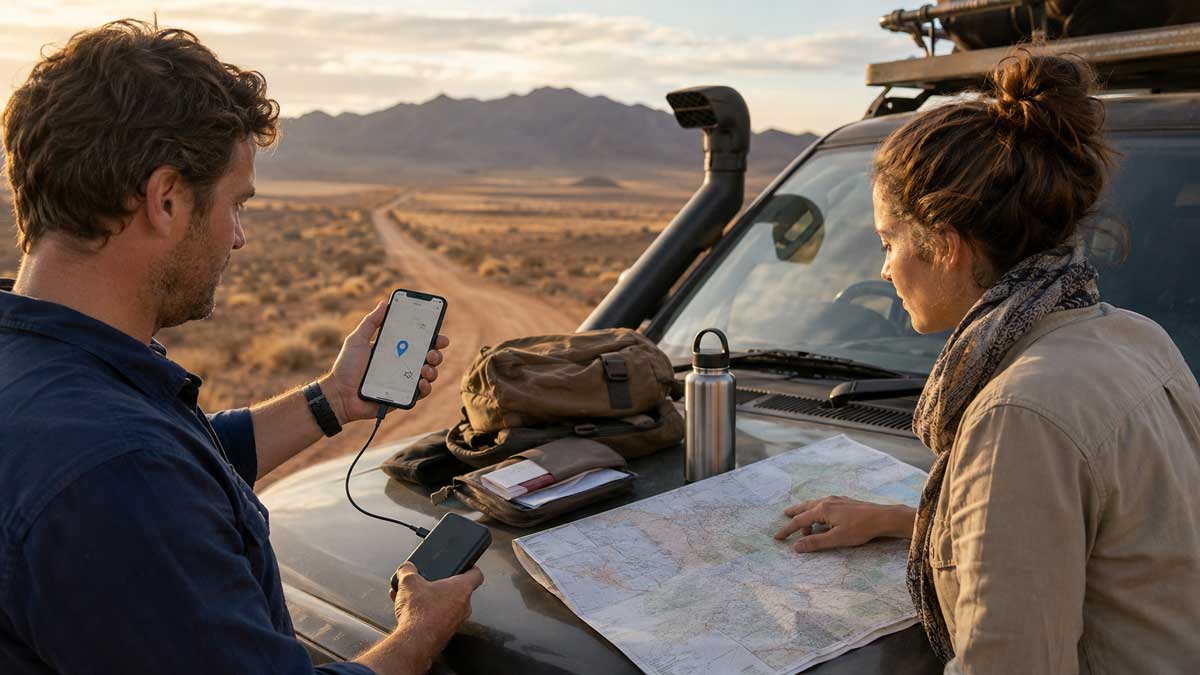
eSIM, Local SIM or International Roaming: Which Is Better?
There is no single connectivity solution that is automatically right for every traveller to Africa.
A local physical SIM remains an excellent option for someone spending an extended period in one country. It can provide direct access to a domestic network, competitive local data pricing and straightforward top-ups. For travellers comfortable buying and registering a SIM after arrival, there may be little reason to avoid it.
International roaming remains the simplest option because the traveller continues using their existing home service. For people whose mobile plan includes affordable African roaming, or business travellers whose company covers the cost, it can be perfectly practical. The important precaution is to understand the tariff before departure rather than discovering the cost after substantial data has already been used.
An eSIM becomes particularly attractive when convenience, predictable data costs and cross-border travel are important. It allows the traveller to organise connectivity in advance, retain the physical home SIM where the device supports it and potentially use one regional package across several countries.
The decision should therefore be based on the itinerary rather than a universal claim that one technology is always superior. Someone visiting Johannesburg for three days has different needs from a family spending three weeks travelling through Namibia. A honeymoon combining Tanzania and Zanzibar differs again from a multi-country safari through Kenya and Tanzania
What eSIM technology changes is the ability to make that decision before departure and arrive with the chosen solution already prepared.
What Happens When You Leave the City and Go on Safari?
The real test of any African connectivity advice begins when the traveller leaves the airport and major cities behind.
Safari destinations are intentionally remote. Their attraction lies in wilderness, wildlife and distance from heavily developed environments. It is therefore unrealistic to expect every game-drive road, desert route or remote concession to provide the same mobile connectivity as Johannesburg, Nairobi or Cape Town.
Signal can weaken or disappear as travellers move into national parks and sparsely populated regions. An eSIM cannot solve this any more than a physical SIM can. If the underlying mobile network does not provide coverage at that location, the format of the SIM card becomes irrelevant.
This is why good connectivity planning needs to include preparation for periods without connectivity. Important travel documents and contacts should be available offline, maps can be downloaded before leaving strong signal areas and travellers on self-drive journeys should carry sufficient battery capacity. Someone should also know the intended route, particularly when travelling through remote regions.
Professional safari operations add another layer of protection. Many lodges, guides and camps use radio, satellite systems or other operational communications where ordinary mobile service is unreliable. Some remote lodges now provide excellent satellite-based Wi-Fi even where conventional cellular coverage remains weak.
The correct expectation is therefore not uninterrupted signal. It is a combination of the best available mobile connectivity and sensible preparation for the moments when that connectivity is unavailable.
Why Connectivity Matters More When Something Goes Wrong
Losing mobile signal while trying to upload a photograph is an inconvenience. Being unable to communicate during an emergency is very different.
If a traveller becomes seriously ill, is involved in a road accident or feels threatened, the first challenge is often establishing what has happened and where assistance is required. The traveller may need to share their location, communicate symptoms, contact accommodation or reach an emergency service. An insurer, travel consultant and family member may subsequently need information.
Mobile connectivity allows those communications to begin.
It does not manage them.
This distinction is central to the TravelSafe SOS proposition. An eSIM provides a connection where supported mobile coverage exists, but it cannot assess whether a medical situation requires an ambulance, determine which facility is appropriate, coordinate responders or manage communication with the people who need to know what is happening.
TravelSafe SOS provides that additional layer through professional emergency coordination. When assistance is required, the objective is to establish the traveller’s location and circumstances, assess what type of response is appropriate and coordinate the next steps. Relevant parties, including the traveller’s insurer, travel consultant and nominated next of kin, can also be kept informed as the situation develops.
This is why combining connectivity and emergency assistance makes sense.
Mobile data helps the traveller communicate. Professional emergency coordination helps turn that communication into an appropriate response.
For someone preparing to travel to Africa, arranging both before departure creates a much stronger safety net than simply hoping they will be able to work everything out if something goes wrong.
Why Every Traveller to Africa Should Get an eSIM Before They Fly
Why TravelSafe SOS Is Combining Connectivity With Emergency Assistance
Most travel eSIM services solve one problem: they provide mobile data.
That is useful, but connectivity is only one part of what happens when a traveller needs help.
TravelSafe SOS approaches the problem from the opposite direction. The platform was created around emergency assistance for travellers in Southern and East Africa. When a medical or security emergency occurs, the traveller needs more than an internet connection. Someone needs to establish what has happened, understand where the traveller is located and coordinate an appropriate response.
Adding eSIM connectivity strengthens that existing system.
Every TravelSafe SOS 30-day activation is planned to include 1GB of complimentary travel data at no additional charge, subject to compatible devices, supported destinations and the final service conditions.
The objective is not to turn TravelSafe SOS into another company competing to sell the cheapest gigabyte of mobile data. It is to help travellers begin their journey connected so that the communication tools supporting modern travel and emergency assistance are available as early as possible.
A traveller who has already installed their connectivity before departure can land, switch on their phone and begin the journey without first solving the problem of how to get online. If assistance is later required, TravelSafe SOS is already part of that connected environment.
This creates a simple proposition: arrive connected and travel protected.
Is 1GB Enough for an African Holiday?
One gigabyte of data needs to be understood in the context of how the traveller intends to use their phone.
It is not designed for spending hours streaming films, uploading large video libraries or continuously watching high-definition social media content. Travellers who use their phones heavily will require additional data.
For normal travel communication, however, 1GB can be surprisingly useful.
Messaging, checking email, accessing accommodation details, occasional web searches and using travel applications generally consume far less data than video streaming. Navigation can also be managed efficiently when travellers download offline maps before departure and use mobile data primarily for live updates and occasional searches.
The TravelSafe SOS complimentary allocation should therefore be viewed as arrival and essential travel connectivity, rather than an unlimited holiday data package.
That distinction is important because it reflects the purpose of the product. The aim is to help travellers arrive with working mobile data and immediate access to essential communication. Those who require significantly more data can then choose additional connectivity according to their needs.
It also creates a practical benefit from the moment the traveller lands. Emergency applications traditionally provide value only when something goes wrong. Complimentary connectivity provides value immediately, even if the traveller enjoys a completely incident-free holiday.
That changes the relationship between the traveller and the application.
TravelSafe SOS is no longer simply sitting on the phone waiting for an emergency. It is helping the traveller from the beginning of the journey.
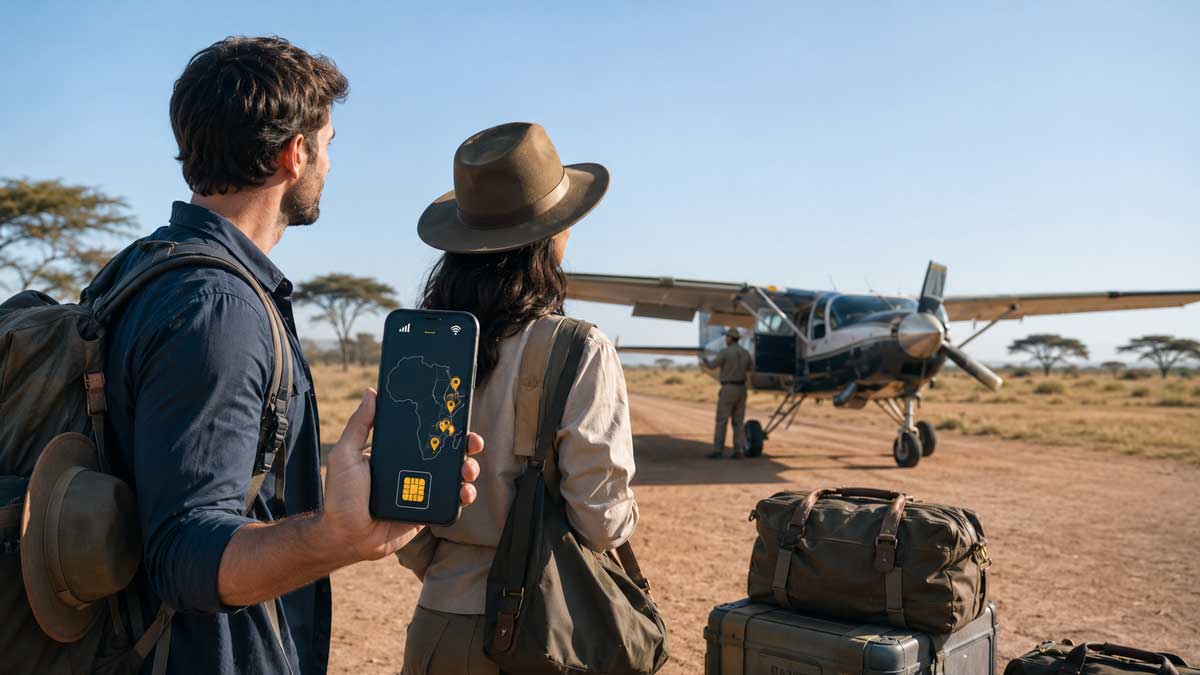
Can One eSIM Work Across Several African Countries?
For many travellers, this is one of the strongest arguments for arranging an eSIM before departure.
African holidays frequently cross borders. Someone may fly into Johannesburg before travelling to Botswana and Zimbabwe. Another traveller may combine Kenya and Tanzania. A honeymoon could include a safari in Tanzania followed by Zanzibar, while a longer Southern African itinerary may cross Namibia, Botswana, Zambia and Zimbabwe.
Buying a physical SIM in every country can become inconvenient.
A regional eSIM can potentially remove much of that friction by allowing one digital profile to connect to partner networks across several supported countries. The traveller does not necessarily need to replace the SIM or purchase another package every time an international border is crossed.
However, regional coverage should never be assumed simply because a product is described as an “Africa eSIM.”
Africa consists of more than 50 countries with different telecommunications markets and mobile networks. Packages vary considerably in the destinations and networks they support.
Travellers should therefore check the exact country list against their itinerary before purchasing or activating any regional eSIM.
They should also understand that crossing a border can change the underlying network. An eSIM may connect to one operator in South Africa and another in Botswana. Coverage characteristics will consequently change even though the traveller continues using the same eSIM profile.
This is why TravelSafe SOS is developing country and regional connectivity information alongside the eSIM service. The useful question is not simply whether an eSIM works “in Africa.” It is whether it is suitable for the countries and routes included in a particular journey.
Check That Your Phone Supports eSIM Before You Travel
eSIM technology is increasingly common in modern smartphones, but compatibility should never be assumed.
Many recent Apple, Samsung and Google devices support eSIM, along with selected models from other manufacturers. Support can nevertheless vary by model, country of purchase and mobile carrier.
Travellers should check their specific handset rather than relying on the fact that another phone with a similar model name supports the technology.
The device may also need to be unlocked from the home mobile carrier before it can use another network profile. This can be particularly relevant for phones supplied as part of a carrier contract.
The best time to discover a compatibility problem is at home, not after arriving in another country.
TravelSafe SOS intends to make compatibility checking part of the eSIM experience so that travellers can determine whether their device is suitable before attempting activation.
Where eSIM is not supported, the emergency assistance functionality of TravelSafe SOS remains valuable. Travellers can continue using their normal roaming service, local physical SIM or other available connectivity solution.
The eSIM is an enhancement to the safety platform, not a requirement for receiving TravelSafe SOS assistance.
Install Your eSIM Before You Board the Aircraft
One of the major advantages of eSIM technology is the ability to prepare connectivity before travelling.
Where the service allows it, travellers should install the eSIM while they still have reliable internet access at home. This gives them time to follow the setup instructions carefully and resolve any compatibility or configuration questions before departure.
Installation and activation are not necessarily the same thing.
Depending on the eSIM provider and package, a profile may be installed before travel but only begin its validity period when it first connects to a supported network. Other products may use different activation rules.
Travellers should therefore follow the specific instructions provided with their package rather than assuming every eSIM works identically.
The ideal outcome is simple. When the aircraft lands and flight mode is switched off, the traveller has already completed the technical preparation.
That is the entire point of arranging connectivity before flying.
Avoid Unexpected Roaming Charges
Using an eSIM alongside a home SIM is convenient, but travellers need to understand their phone settings.
If both services remain active, the device needs to know which SIM should be used for mobile data. Otherwise, the home SIM may continue using international roaming and generate charges even though a travel eSIM has been installed.
The exact settings vary between Apple and Android devices, but the principle is straightforward. The travel eSIM should normally be selected for mobile data when that is the intended service, while unwanted data roaming on the home SIM should be disabled.
Travellers who want to continue receiving calls or SMS messages on their home number should also check what their domestic carrier charges for those services while abroad.
There is no need to make the process intimidating. Modern dual-SIM phones are designed to manage multiple services.
The important thing is to configure them deliberately rather than assume that installing an eSIM automatically prevents the home network from roaming.
This is another reason to complete the setup before departure, when the traveller has time and reliable connectivity to check everything properly.
What Should You Download Before Leaving Home?
Even with an eSIM installed, travellers should prepare for periods without mobile signal.
Offline maps are particularly valuable for self-drive journeys and can be downloaded before departure or while connected to reliable Wi-Fi. Accommodation confirmations, important telephone numbers, travel insurance details and copies of essential documents should also be accessible without depending entirely on cloud storage.
The same principle applies to the TravelSafe SOS profile. Emergency information is most useful when it has been completed accurately before the journey begins.
Travellers heading into genuinely remote regions should think beyond connectivity altogether. A power bank is valuable on long driving days, and somebody should know the planned route when travelling through isolated areas. Safari guests should understand how their lodge communicates in an emergency if conventional mobile signal is unavailable.
None of these preparations suggests that travelling through Africa is inherently dangerous.
They are simply sensible precautions for journeys through unfamiliar and sometimes remote environments.
The best travel technology works alongside preparation rather than replacing it.
What Happens If You Need Help?
This is the point where an eSIM and a travel safety application perform very different jobs.
TravelSafe SOS emergency assistance
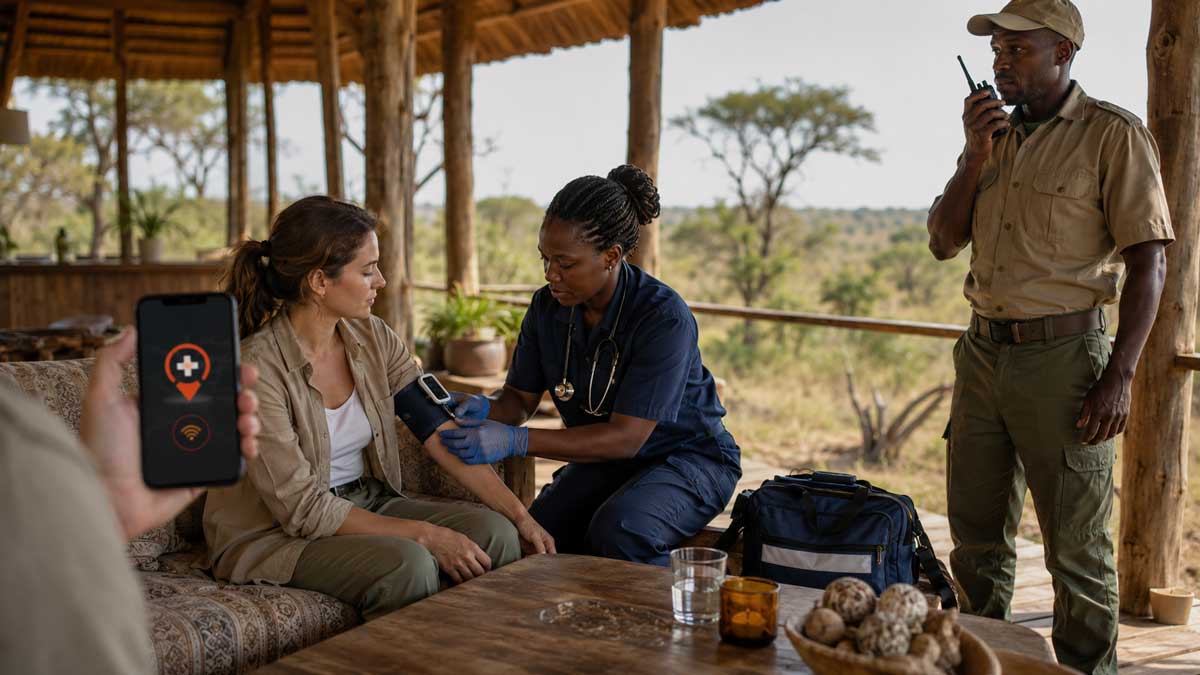
Imagine a traveller becomes ill at a lodge in an unfamiliar destination. Mobile connectivity may allow that person to send a message, share a location or make contact with someone who can help.
The next question is more difficult.
Who should be contacted?
Does the traveller require medical advice, transport to a clinic, an ambulance or a higher level of intervention? Which medical facility is appropriate? Should the insurer be contacted immediately? Does the travel consultant need to know? Who updates the traveller’s family?
These questions become particularly difficult when the traveller does not understand the local emergency infrastructure.
TravelSafe SOS is designed to provide coordination at this point.
When an emergency is activated, the control centre can assess the situation and determine what type of response is appropriate. Depending on the circumstances, this may involve medical or security assistance and coordination with relevant responders.
The traveller’s nominated next of kin, travel consultant and insurer can also be informed where appropriate, reducing the burden on the traveller or companions during an already stressful situation.
Connectivity helps start the conversation.
The control centre helps determine what happens next.
Why Travel Insurance Is Still Essential
Including emergency assistance and connectivity within TravelSafe SOS does not replace comprehensive travel insurance.
Travellers should continue to purchase suitable insurance for their journey and understand the terms, exclusions and emergency procedures of the policy.
Travel insurance provides financial protection for covered events. Depending on the policy, this may include medical treatment, evacuation, cancellation, lost luggage and other travel-related losses.
TravelSafe SOS performs a different function.
Its purpose is to help coordinate the immediate practical response when something goes wrong.
The two services therefore work best together rather than being viewed as alternatives.
If a serious medical event occurs, for example, TravelSafe SOS can assist with coordinating the situation while the insurer becomes involved according to the policy terms and any required authorisation process.
This distinction matters because an emergency can begin long before an insurance claim exists.
The first concern is the traveller.
Financial administration follows.
Why Your Travel Agent and Next of Kin Matter Too
A serious travel incident creates consequences beyond the immediate medical or security problem.
A travel consultant may need to rearrange flights, transfers or accommodation. An insurer may need medical information or documentation. Family members at home may receive partial information and understandably become anxious.
If the traveller is seriously ill or injured, expecting them or their travelling companion to manage every communication is unrealistic.
One of the strengths of the TravelSafe SOS model is that nominated contacts can be brought into the communication process.
For travellers who booked through a professional travel agent or tour operator, this is particularly valuable. The consultant already understands the itinerary and may be able to assist with the practical consequences of an incident while emergency responders focus on the immediate problem.
Family members also benefit from knowing that the traveller is receiving professional assistance rather than trying to interpret fragmented messages from thousands of kilometres away.
Emergency response is therefore not simply about dispatching assistance.
It is also about coordinating information.
The USD 20 Question
TravelSafe SOS currently costs USD 20 for a 30-day activation, charged according to the applicable payment arrangements.
With the planned inclusion of 1GB of complimentary travel eSIM data, the value proposition changes substantially.
The traveller is no longer paying only for a service they hope never to use.
They receive something useful immediately: mobile connectivity for the journey, subject to compatibility and coverage.
Behind that connectivity sits professional emergency coordination should it ever be required.
The comparison should therefore not simply be between TravelSafe SOS and a standalone eSIM provider.
A standalone eSIM sells data.
TravelSafe SOS combines travel connectivity with access to emergency support across its Southern and East African operating region.
For a traveller already planning to purchase mobile data for an African holiday, that becomes a fundamentally different proposition.
Before You Fly to Africa
The smartest time to organise travel connectivity is before departure, when there is no pressure and reliable internet access is available.
Check that your phone supports eSIM and that it is unlocked where necessary. Compare your home network’s roaming costs with the alternatives available for your itinerary. If you are visiting several countries, confirm that the eSIM package covers every destination rather than assuming that an “Africa” package is continent-wide.
Install the eSIM according to the provider’s instructions and understand when its validity period begins. Make sure the correct SIM is selected for mobile data and disable unwanted roaming on your home service. Download important maps, travel documents and contacts for offline use before heading into remote areas.
Finally, think about what would happen if something went wrong.
Travel insurance should be in place. Important emergency information should be accessible. Family should know the broad itinerary. If using TravelSafe SOS, complete the traveller profile and emergency contact information before departure rather than waiting until assistance is needed.
This is not complicated travel preparation.
It is modern travel preparation.
Arrive Connected. Travel Protected.
An African holiday may take you from one of the world’s great cities into a wildlife reserve, across a desert road, onto a tropical island or between several countries during a single journey.
That diversity is one of the reasons people travel to Africa.
It is also why connectivity should be planned rather than assumed.
An eSIM makes that preparation easier. It allows compatible travellers to arrange mobile data before departure, retain their normal SIM where supported and potentially remain connected across several countries without repeatedly purchasing physical SIM cards.
But connectivity is only the beginning.
TravelSafe SOS is bringing mobile connectivity and professional emergency coordination together so that travellers can receive practical value from the application from the moment they arrive while retaining access to help if something goes wrong.
The planned complimentary 1GB travel eSIM is therefore not intended to turn TravelSafe SOS into another mobile data company.
It serves a much more important purpose.
You arrive connected.
You know who to contact.
Your emergency information is already prepared.
And if assistance is required, a professional control centre can help coordinate the response and keep your insurer, travel consultant and nominated next of kin informed.
For USD 20 for 30 days, that is the proposition behind TravelSafe SOS