
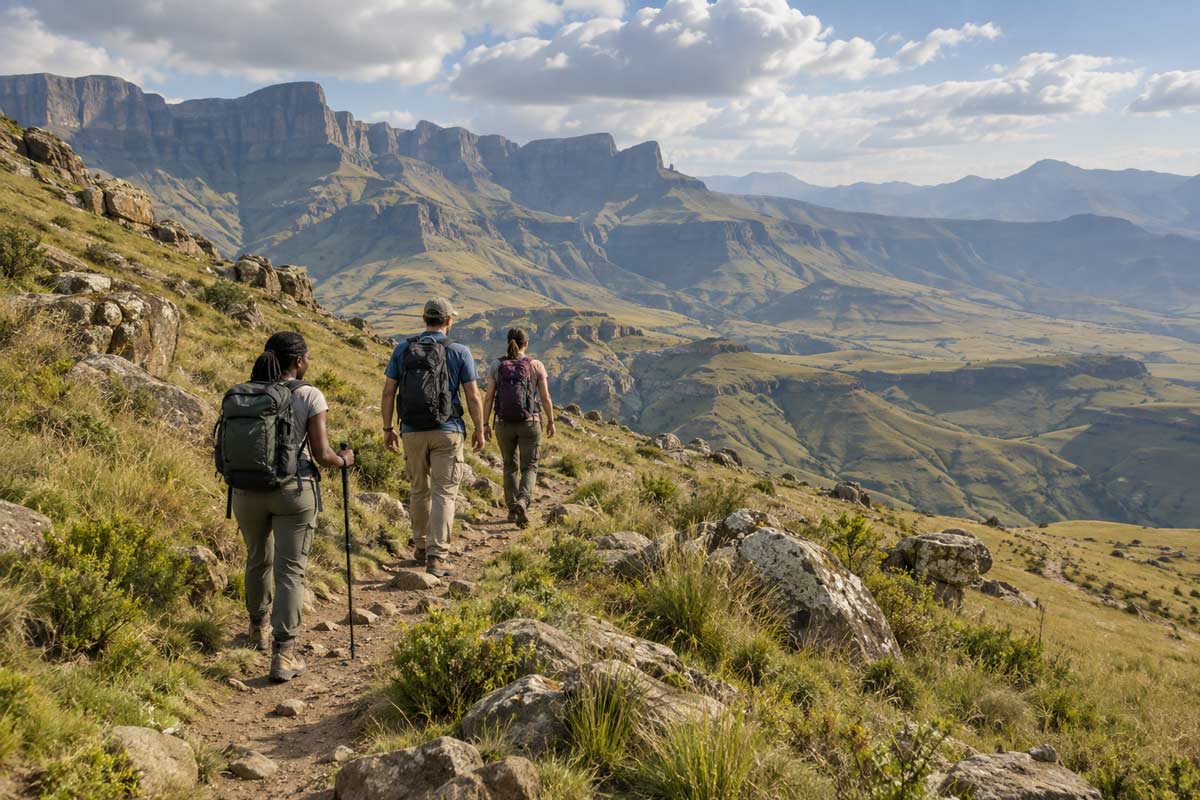
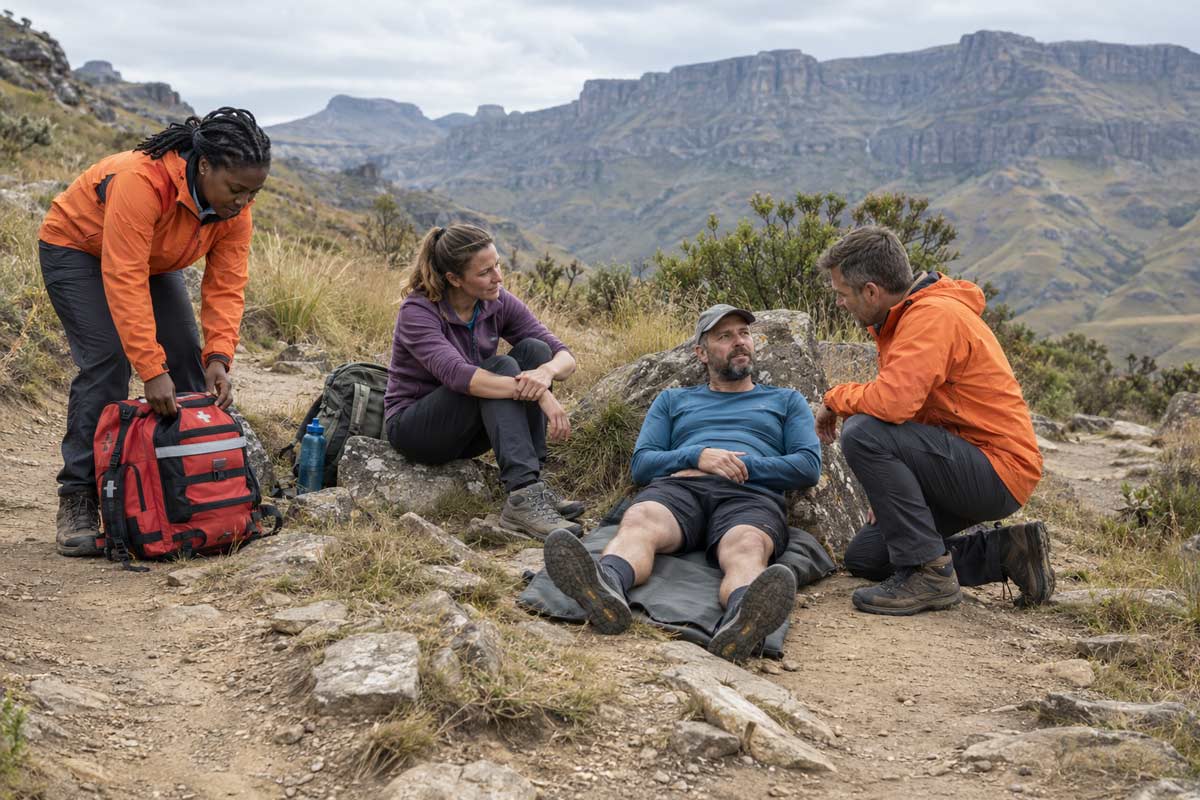
You lose your footing on a remote trail and land heavily. Your ankle cannot support your weight, daylight is fading and the nearest road may be several hours away. Your phone displays a location, but you do not know the name of the trail, which rescue service covers the area or whether your insurer will authorize assistance.
Your first decision should be to stop.
Do not stand automatically or continue walking because you are worried about delaying the group. Check for immediate dangers such as falling rocks, fire, fast-moving water, unstable ground, wildlife or deteriorating weather. Move only if remaining where you are creates a greater and more immediate risk.
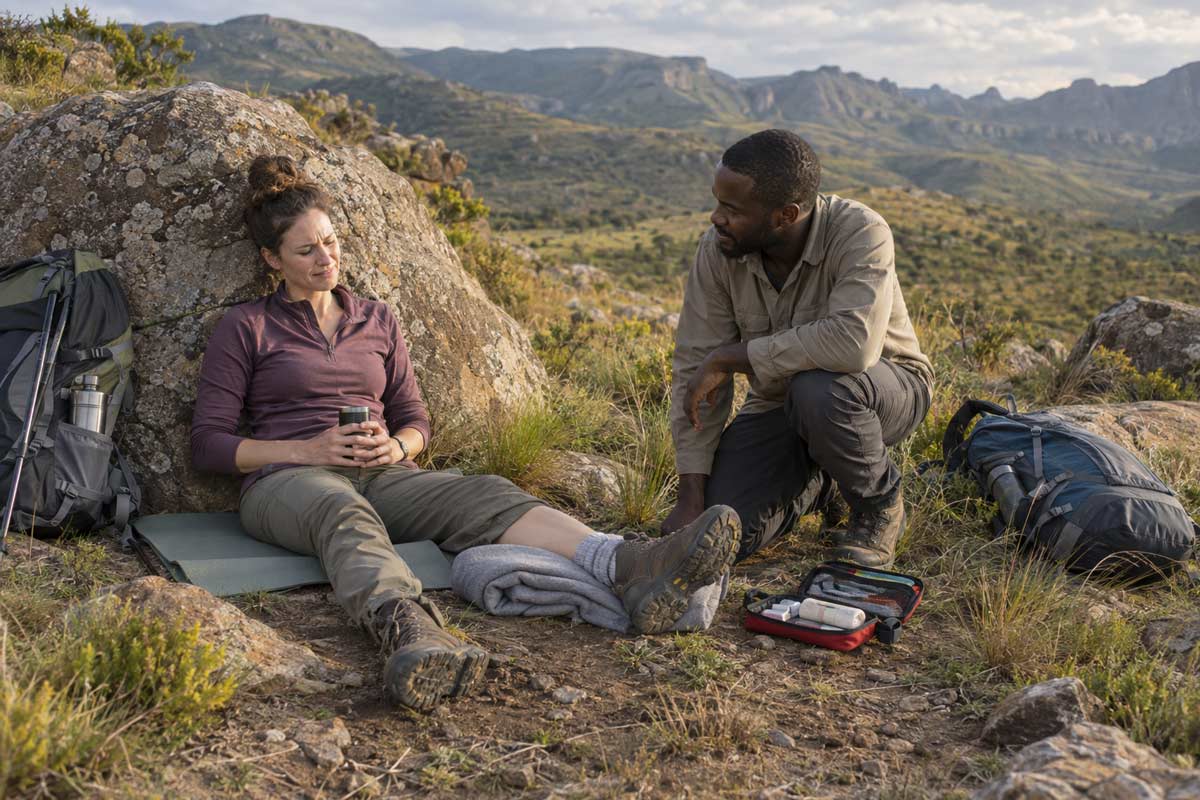
Check yourself and your companions for severe bleeding, breathing difficulty, confusion, loss of consciousness or intense pain. If you suspect a head, neck or spinal injury, avoid unnecessary movement and obtain professional assistance through the most reliable communication method available.
American Red Cross guidance for head, neck and spinal injuries
A hiking injury in a remote part of Africa is not only a first-aid problem. Someone must establish where you are, understand what has happened, identify appropriate available assistance and connect the incident with your insurer, travel agent and family.
That emergency support pathway must exist before you start walking.
Should You Try to Continue Walking?
Pain, shock and adrenaline can make an injury appear less serious immediately after a fall. Trying to walk may worsen a fracture, joint injury, bleeding or exhaustion. A person who has struck their head may also be confused without recognizing the seriousness of their condition.
Do not continue simply to protect the itinerary or avoid inconveniencing other travellers. Stop, assess the situation and follow the instructions of a qualified guide, first aider or emergency professional where one is available.
Urgent professional assistance may be required when an injured traveller has severe bleeding, difficulty breathing, chest pain, confusion, loss of consciousness, an obviously deformed limb, an inability to bear weight, a serious allergic reaction, signs of heat illness or symptoms that are rapidly deteriorating.
American Red Cross guidance for muscle, bone and joint injuries
TravelSafe SOS does not diagnose injuries or replace professional medical care. If an SOS alert transmits successfully, it gives the traveller an established pathway to a control centre that can assess the available information and begin coordinating appropriate available assistance.
Your Location Could Determine the Response
Telling someone that you are “on the mountain” or “somewhere along the trail” is rarely enough. Hiking routes may cross national parks, private reserves, community land or remote wilderness without street addresses or vehicle access.
Preserve the most accurate location information available. This may include:
- GPS coordinates
- The trail or route name
- Your starting point and intended destination
- Your direction of travel
- The last recognizable landmark
- The time of the incident
- The number of people involved
- Whether the injured traveller can move
Do not wander away to search for a signal unless remaining where you are presents a greater danger and moving has been assessed as safe. An injured person who remains at a known location may be easier to find than somebody who continues along an uncertain route.
When a transmitted TravelSafe SOS alert reaches the control centre, available location information can help the operator understand where the emergency has occurred. Your registered itinerary, accommodation and tour-operator details may provide essential additional context.
Without this preparation, valuable time could be lost establishing which trail you selected, where you started and which local authority or response provider should be approached.
What If You Have No Mobile Signal?
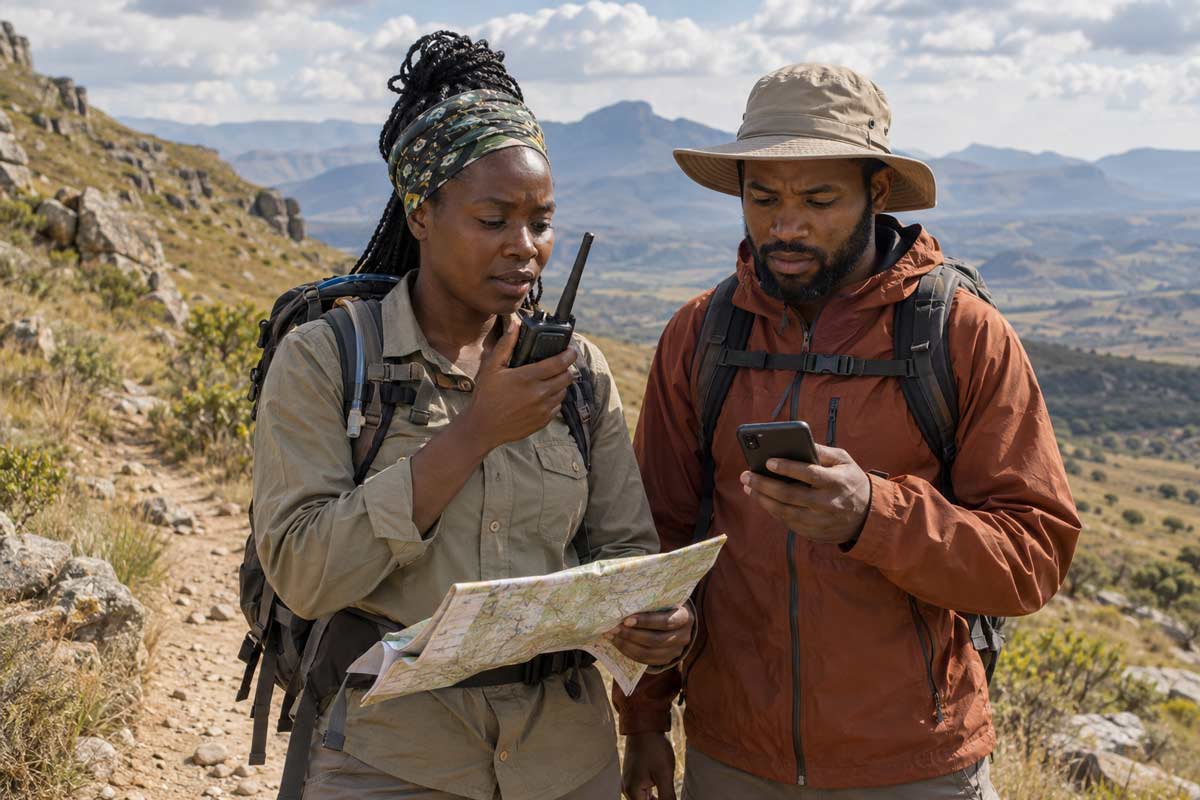
A smartphone may establish a GPS position even when it cannot transmit a call, message or SOS alert. Seeing your position on a map does not mean that you have a working connection to emergency support.
If connectivity is available, activate TravelSafe SOS and remain available for contact where circumstances permit. If the alert cannot transmit, use the safest available alternative. This could include a voice call, SMS, satellite phone, satellite messenger, guide radio, park authority, lodge or another hiking party.
Using Starlink in remote parts of Africa
Preserve battery power and protect your phone from extreme heat, cold and water. Avoid repeatedly calling different people without a clear purpose. If one person must leave to obtain assistance, they should carry accurate coordinates and incident information, and only depart when doing so is safer than remaining together.
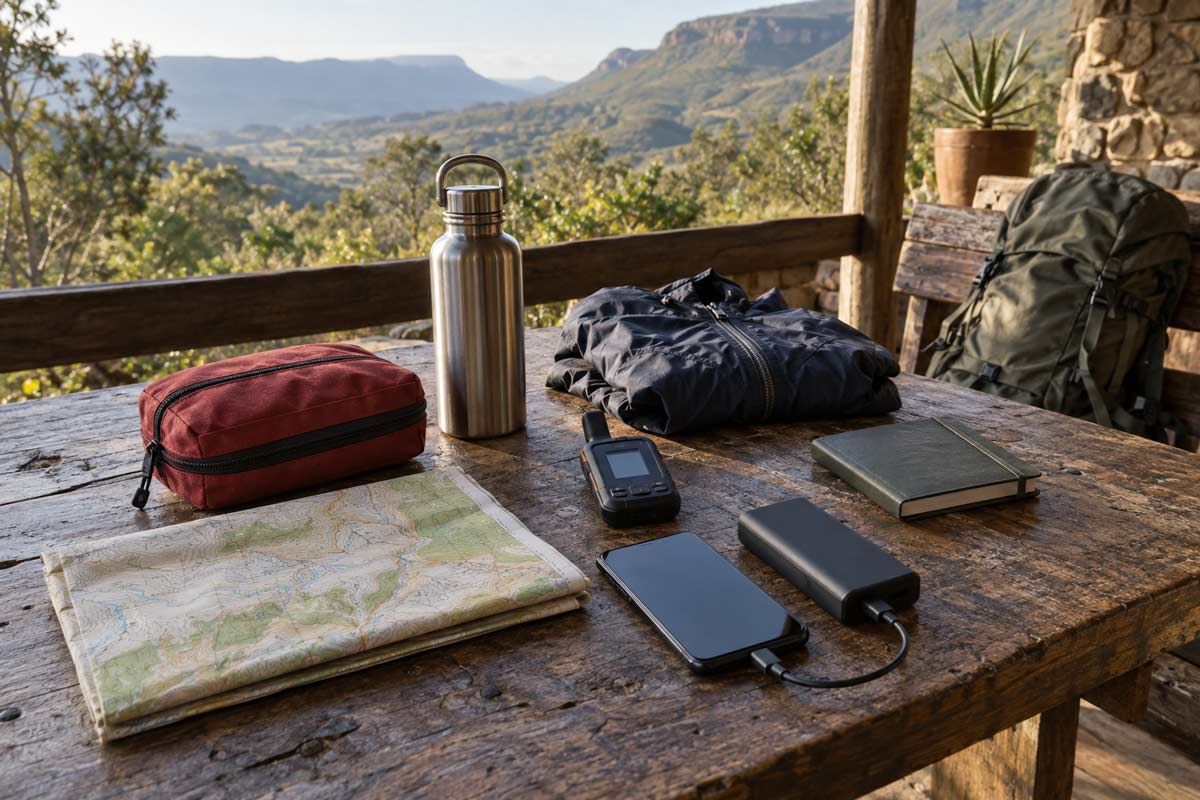
Connectivity cannot be guaranteed on every African trail. TravelSafe SOS should form part of a layered emergency plan that includes offline mapping, a charged phone, backup power, suitable communications and an agreed missed-arrival procedure.
A Guide and TravelSafe SOS Perform Different Roles
A qualified guide understands the route, terrain, local procedures and immediate environment. TravelSafe SOS does not replace that expertise. The app provides an additional emergency coordination pathway if an alert can be transmitted and the incident requires assistance beyond the trail.
Guided gorilla trekking in Uganda and Rwanda, for example, takes place within established wildlife-authority procedures. Independent mountain and wilderness routes may have very different communication and rescue arrangements. Every traveller must understand the emergency system for the activity and destination before departure.
Gorilla trekking safety in Uganda and Rwanda
First Aid Alone Does Not Coordinate Assistance
First aid may help control bleeding, protect an injured limb or keep a traveller stable. It does not determine which organization can reach the location, whether an insurer must authorize assistance or who should inform the traveller’s family.
Depending on the destination, a response could involve park authorities, police, emergency medical services, mountain rescue, a private medical provider, a tour operator, accommodation staff or an insurer-appointed assistance company.
An injured traveller or distressed companion may otherwise have to contact several organizations while trying to establish which one can help. Family members at home may begin making separate calls without knowing the traveller’s location, condition or who is coordinating the response.
Emergency medical help on an African safari
TravelSafe SOS gives the traveller one established emergency pathway. If an SOS alert transmits successfully, the control centre can attempt to contact the traveller, assess the available information and coordinate appropriate available assistance. Registered medical, insurance, travel-agent and next-of-kin details can support the response without relying entirely on an injured person to find policy numbers or explain their medical history.
Register Before You Reach the Trail
Download and register for TravelSafe SOS before travelling. Complete your medical information, current medication, insurance and assistance-provider details, registered travel agent, nominated next of kin and current itinerary.
Tell somebody where you are hiking, which route you intend to follow and when you expect to return. Agree on what they should do if you miss the scheduled check-in. Make sure a travelling companion knows how to activate SOS if you cannot use the phone yourself.
TravelSafe SOS cannot prevent a fall, guarantee connectivity or promise a particular rescue time. It can provide a prepared coordination pathway when an injury leaves you least able to manage the emergency alone.
How Are Injured Hikers Located and Reached?
Finding an injured hiker is not always as simple as sending an ambulance to a street address. Trails may cross national parks, private reserves, mountain terrain or remote community land. The closest organization may not be equipped to provide the medical assistance required.
Depending on the destination and severity of the incident, assistance may involve park authorities, mountain rescue organizations, police, emergency medical services, private medical providers, tour operators, accommodation teams or an assistance company appointed by the traveller’s insurer.
Mountain Club of South Africa emergency rescue contacts
The response may begin on foot. An injured hiker might first need to be reached, assessed and assisted to a trailhead or vehicle-accessible point. Weather, darkness, terrain, communications and responder availability can all affect how long this takes.
Accurate information is essential. GPS coordinates, the route, the last recognizable landmark, the number of people involved and the traveller’s ability to move can help responders evaluate the situation. A completed TravelSafe SOS profile provides additional information about the traveller, itinerary and organizations that may need to become involved.
No app can remove the physical difficulties of a remote rescue. TravelSafe SOS helps address the coordination problem surrounding it.
What Happens After a TravelSafe SOS Alert?
When a successfully transmitted SOS alert reaches the TravelSafe SOS control centre, an operator attempts to contact the traveller and assess the available information.
The response process may include:
- Reviewing the available location and registered profile information.
- Attempting to establish what has happened.
- Assessing the nature and apparent urgency of the emergency.
- Identifying appropriate available local assistance.
- Contacting relevant emergency, medical or operational services.
- Connecting the incident with the traveller’s insurer or assistance provider where required.
- Alerting the registered travel agent and nominated next of kin according to the applicable response procedures.
- Continuing to support coordination through the appropriate local and insurance pathways.
How the TravelSafe SOS control centre responds
This creates one established emergency pathway when an injured traveller may be frightened, in pain or unable to communicate clearly. It also reduces the risk of family members and travel contacts approaching different organizations without knowing who is coordinating the response.
TravelSafe SOS does not control local responders or guarantee a particular rescue method, arrival time or evacuation outcome. Its value lies in connecting the emergency with the available people, information and services needed to manage it.
Why Your Travel Insurance Details Matter
Travel insurance does not automatically mean every hiking, treatment, rescue or evacuation expense is covered. Policies differ, and exclusions may apply to altitude, unguided hiking, technical climbing, remote-area rescue, helicopter evacuation, pre-existing medical conditions or leaving established routes.
Before travelling, ask your insurer:
- Is hiking or trekking covered at the planned altitude?
- Are search and rescue expenses included?
- Is emergency medical evacuation covered?
- Does the activity have to be guided?
- Must the insurer authorize transport or treatment in advance?
- Is helicopter evacuation covered when medically necessary?
- Which assistance company must be contacted?
- Are declared pre-existing medical conditions covered?
Add the correct policy number and emergency-assistance contact information to your TravelSafe SOS profile. An expired policy, incorrect number or missing assistance contact creates another problem during an already difficult situation.
TravelSafe SOS does not replace comprehensive travel insurance or suitable medical evacuation cover. It helps make the relevant information available when the traveller may be least capable of finding or communicating it.
Your Family Should Not Have to Organize the Emergency
A family member at home may know that you are hiking in Africa without knowing the route, park, guide, accommodation or expected return time. If you miss a check-in, they may not know whether you are delayed, lost, injured or simply outside mobile coverage.
Your travel agent may hold detailed itinerary information. Your insurer may control access to its medical-assistance process. Your tour operator may understand the local geography, while your lodge may know which route you intended to follow.
These people become far more useful when their information is connected before the emergency.
By registering your travel agent, insurer, nominated next of kin and current itinerary with TravelSafe SOS, you create a clearer support network. If an SOS alert transmits successfully, the control centre has a stronger starting point for assessing the incident, coordinating appropriate available assistance and alerting the people responsible for supporting you.
The objective is not to alarm your family. It is to prevent them from having to reconstruct your journey while you may be injured and unable to explain what has happened.
Set Up Your Emergency Support Before You Start Walking
A remote trail is not the place to search for policy numbers, emergency contacts or the name of a suitable responder.
Before hiking or trekking in Africa:
- Download and register for TravelSafe SOS.
- Complete your medical and medication information.
- Add your insurer and emergency-assistance details.
- Register your travel agent and nominated next of kin.
- Enter your current itinerary and accommodation.
- Tell somebody which route you are following.
- Agree on an expected return time and missed-arrival procedure.
- Save essential contacts and maps offline.
- Charge your phone and carry suitable backup power.
- Ensure a companion knows how to activate SOS.
Complete these preparations before travelling, while you have access to accurate medical information, policy documents and contact details.
Register for TravelSafe SOS before travelling
If an injury leaves you unable to walk, think clearly or coordinate the emergency yourself, a transmitted TravelSafe SOS alert can connect you with a control centre that can assess the available information and begin coordinating appropriate available assistance.
First aid addresses the immediate injury. TravelSafe SOS helps address the emergency response around it.