

Travel insurance and emergency assistance are not the same service, although there may be some overlap between them. Travel insurance primarily provides financial protection for eligible losses and expenses under the terms of a policy. Many insurers also provide 24-hour assistance services that can offer advice, approve treatment, communicate with medical providers or help arrange evacuation.
The precise service depends on the insurer, policy and assistance company. Travellers should never assume that all insurance policies provide the same emergency support or that every claim, treatment or evacuation will be automatically approved.
TravelSafe SOS provides a different layer of support. It gives registered travellers a direct way to activate an emergency alert and share available location and account information with a 24-hour control centre. The control centre can attempt to contact the traveller, assess the available information and help coordinate an appropriate local response.
This distinction matters when travelling through Southern and East Africa. A traveller may be injured on an unfamiliar road, become seriously ill at a remote safari lodge, feel threatened in an urban area or need assistance somewhere without a clear street address. In these situations, the first challenge is often not submitting an insurance claim. It is establishing what has happened, locating the traveller and connecting the right people quickly.
Travel insurance and TravelSafe SOS should therefore be viewed as complementary forms of protection. Insurance may cover eligible financial consequences. TravelSafe SOS helps coordinate the immediate response.
Why Travel Insurance Remains Essential
TravelSafe SOS is not a replacement for comprehensive travel insurance. International medical treatment, hospital admission, specialist care, emergency transport and medical evacuation can be extremely expensive. A suitable insurance policy may provide cover for these costs, subject to its benefits, exclusions, limits and authorisation requirements.
Depending on the policy, travel insurance may cover:
- Emergency medical treatment
- Hospitalisation
- Ground ambulance costs
- Emergency medical evacuation
- Repatriation
- Trip cancellation or interruption
- Delayed or lost baggage
- Personal liability
- Other specified travel losses
Cover is never unlimited or automatic. Pre-existing medical conditions, alcohol or drug use, participation in excluded activities, travel against official advice, undeclared destinations and failure to obtain authorisation can affect a claim.
Before travelling, read the policy wording and confirm that it covers every country and significant activity on your itinerary. Safari travel, hiking, diving, boating, self-driving and visits to remote islands or wilderness areas may have different conditions or exclusions.
Travellers should also save the insurer’s policy number and 24-hour emergency-assistance contact details somewhere accessible offline. These details should be available to a travel companion or responsible family member in case the insured traveller cannot communicate.
Emergency Medical Help on an African Safari
What Is Immediate Emergency Coordination?
Immediate emergency coordination begins with the situation facing the traveller, not the eventual insurance claim.
The first questions are practical:
- What has happened?
- Is anyone injured or in immediate danger?
- Where is the traveller?
- Can the control centre reach the traveller by phone?
- Is medical, security or another form of assistance required?
- Which suitable responder is available in that location?
- Does the lodge, guide, driver or travel operator need to be contacted?
- Should the insurer, travel agent or next of kin be informed?
During an emergency, these questions can be difficult for a traveller to manage alone. The person may be injured, frightened or unfamiliar with the destination. They may not know the local emergency number, the closest suitable medical facility or how to describe their location.
TravelSafe SOS provides a single point of contact through its emergency alert and control-centre system. When an alert is successfully transmitted, available location and registered profile information can assist the operator in understanding the incident and identifying an appropriate response pathway.
TravelSafe SOS does not operate every ambulance, medical facility or security service used during an incident. It coordinates with appropriate local providers and relevant stakeholders according to the circumstances. The physical response is delivered by the selected responder, while clinical decisions must be made by qualified medical professionals.
How Travel Insurance and TravelSafe SOS Work Together
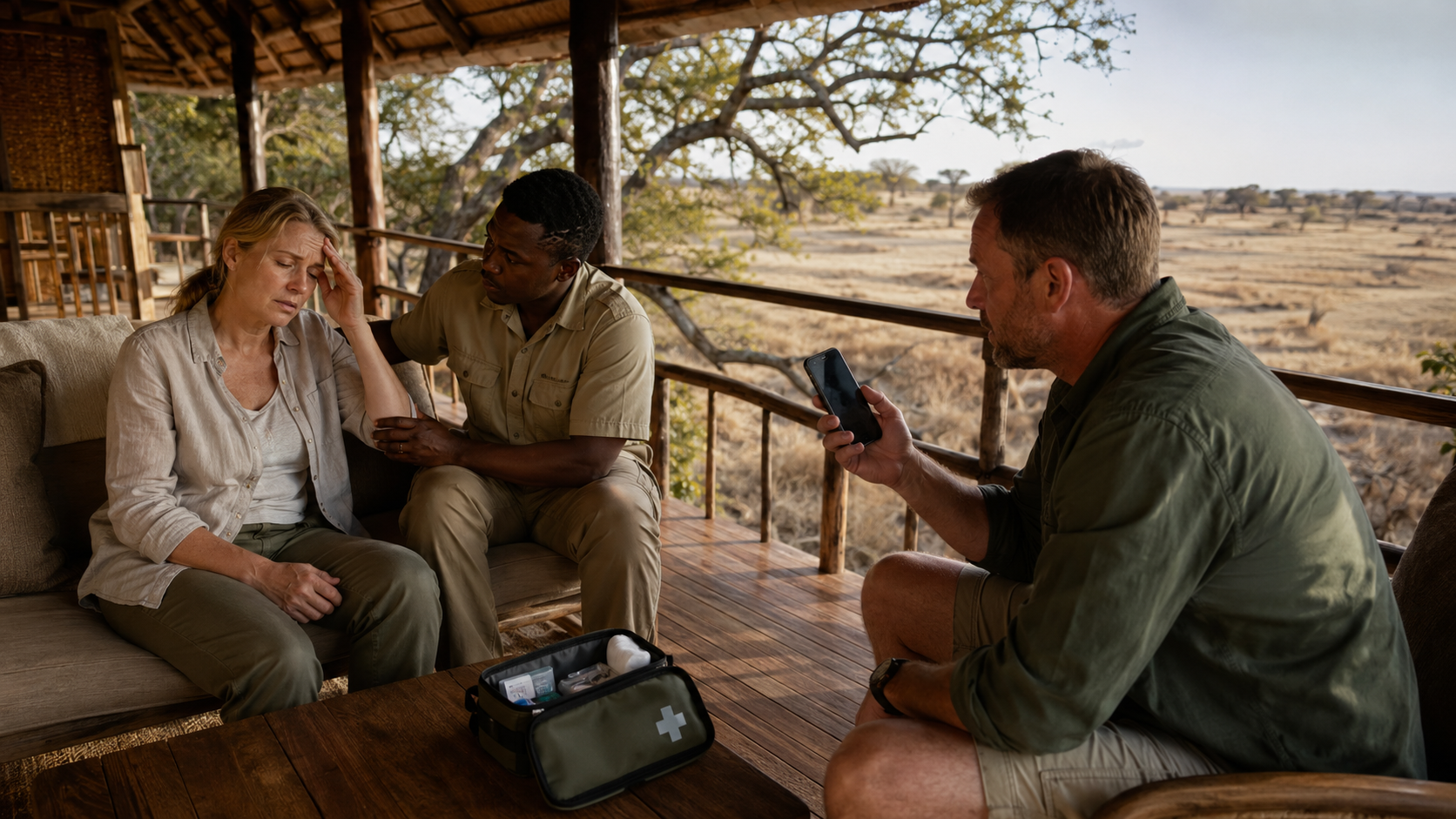
Consider a traveller who develops severe chest pain at a remote safari lodge. Lodge staff may provide immediate assistance and use their local emergency procedures. TravelSafe SOS can help establish the traveller’s location, speak to the traveller or lodge, identify appropriate assistance and begin coordinating communication.
The insurer or its assistance company may need to confirm the traveller’s cover, communicate with medical providers and authorise eligible treatment or evacuation expenses. A doctor or appropriately qualified professional must assess the traveller’s condition and determine what level of care is required.
Each party has a different responsibility:
Function | Travel insurer | TravelSafe SOS | Local responder |
Policy and financial cover | Primary role, subject to policy | No | No |
Receives SOS location | Depends on the service | Yes, when transmitted | When shared |
Initial situation assessment | May provide assistance assessment | Control-centre assessment | Clinical or operational assessment |
Provides physical help | Usually through service providers | No | Yes |
Coordinates communication | Policy and service dependent | Core role during an activated incident | Limited to its response role |
Pays emergency costs | Subject to approval and cover | No | Charges may apply |
Alerts nominated contacts | Service dependent | According to the registered protocol | Usually not a primary role |
The objective is not to choose between insurance and emergency assistance. It is to ensure that the traveller has both an immediate response pathway and appropriate financial protection.
Does Travel Insurance Send an Ambulance?
Some insurers or their contracted assistance companies can arrange an ambulance, medical consultation, hospital admission or evacuation. Others may direct the traveller to a service provider, require supporting information or ask for authorisation before accepting the cost.
The answer therefore depends on the policy and the assistance service attached to it. Travellers should ask their insurer:
- Who should I call first during an emergency?
- Does the assistance centre operate 24 hours a day?
- Can it arrange local medical or ambulance assistance?
- Must treatment be authorised before it begins?
- What happens when urgent care cannot wait?
- Is medical evacuation included?
- Who decides which medical facility is appropriate?
- Which expenses must I pay before claiming reimbursement?
TravelSafe SOS should not be marketed on the claim that travel insurers never provide emergency coordination. That claim is too broad and may be incorrect for many policies. The stronger and more credible commercial message is that TravelSafe SOS supplies a dedicated, location-based emergency coordination service for registered travellers in its African coverage network.
It helps close the gap between experiencing an emergency and connecting the traveller with the people who can respond, provide care, approve expenditure and keep important contacts informed.
Internal link for Mark: Add a forward link here to Article 8, “How the TravelSafe SOS Control Centre Responds to an Emergency,” once it is published.

What Happens After a TravelSafe SOS Alert?
When an emergency alert reaches the TravelSafe SOS control centre, the operator receives the available account and location information transmitted by the app. The operator then attempts to contact the traveller to confirm what has happened and assess the type of assistance required.
The response may involve:
- Confirming the traveller’s condition and immediate safety
- Establishing the traveller’s available location
- Contacting a suitable medical, security or emergency provider
- Communicating with a lodge, hotel, guide, driver or tour operator
- Contacting the traveller’s insurer or assistance company
- Alerting nominated next of kin
- Informing the registered travel agent where applicable
- Continuing communication as the incident develops
Internal link for Mark: Add a forward link to Article 8, “How the TravelSafe SOS Control Centre Responds to an Emergency,” once published.
The control centre does not automatically dispatch the same service for every alert. A medical emergency at a remote lodge requires a different response from a road accident, lost passport or personal-security threat. The operator must assess the available information and identify an appropriate response pathway for the location and circumstances.
If the traveller cannot answer the callback, the control centre may use the available location, registered profile, nominated contacts and relevant travel information to help establish what is happening. The effectiveness of this process depends on the information entered before departure and the connectivity available when the alert is activated.
Can TravelSafe SOS Communicate With Your Insurer?
TravelSafe SOS can help connect the traveller’s immediate emergency response with the insurer or its assistance company when this is relevant and the necessary details are available. This can be particularly important when treatment, ambulance transport or medical evacuation may require financial authorisation.
The control centre may communicate available incident information, help establish which provider is involved and support contact between the parties. However, TravelSafe SOS cannot approve an insurance claim, interpret cover on behalf of the insurer or guarantee that a particular expense will be paid.
The insurer remains responsible for decisions relating to:
- Policy validity
- Benefit limits
- Medical and evacuation cover
- Exclusions
- Pre-existing conditions
- Authorisation requirements
- Claims assessment
- Payment or reimbursement
Travellers should enter their policy number, insurer’s emergency contact details and relevant membership information into their emergency profile before travelling. A copy should also be stored offline and shared with a travel companion.
Who Contacts Your Family and Travel Agent?
During a serious emergency, family members may receive incomplete or conflicting information. A travel agent may know the itinerary but not the traveller’s current condition. The lodge may understand the local situation but have no direct relationship with the traveller’s insurer.
TravelSafe SOS can help create a clearer communication pathway. Depending on the registered protocol and circumstances, the control centre may notify nominated next of kin and keep the traveller’s registered travel agent informed.
This does not mean that every contact will receive unrestricted medical or personal information. Communication must remain consistent with the traveller’s instructions, the service protocol, applicable privacy requirements and the needs of the emergency.
Travellers should nominate the correct contacts before departure. These people should know that they have been selected and understand what they may be asked to do. Contact numbers must include the correct international dialling codes.
Who Pays for an Ambulance, Treatment or Evacuation?
TravelSafe SOS does not pay for ambulances, medical treatment, hospital admission, security services or evacuation. These costs remain the responsibility of the traveller unless they are accepted by an insurer, assistance provider, employer, membership programme or another responsible party.
In a life-threatening emergency, responders may need to act before every financial question has been resolved. In other situations, a service provider may require proof of insurance, a guarantee of payment, credit-card authorisation or payment before dispatch.
Travellers should not assume that showing an insurance policy will automatically secure immediate treatment or transport. They should confirm:
- Whether the insurer guarantees payment directly
- Whether the traveller must pay and claim afterwards
- Which services require prior authorisation
- What happens when prior authorisation is not reasonably possible
- Whether the policy covers private medical care
- Whether evacuation is limited to the nearest appropriate facility
- Whether repatriation to the home country is covered
- What excesses and benefit limits apply
These questions should be answered before departure, not during an emergency.
TravelSafe SOS Terms and Conditions

What TravelSafe SOS Does Not Replace
TravelSafe SOS is an emergency coordination service. It does not replace:
- Comprehensive travel insurance
- Local emergency services
- Qualified medical assessment
- A doctor, paramedic or hospital
- A safari guide or lodge emergency procedure
- A tour operator’s duty of care
- A security provider
- A satellite communication device in a no-signal area
It also cannot guarantee mobile connectivity, an immediate response time, responder availability, insurer approval, hospital capacity or a particular medical outcome.
These limitations do not reduce the value of the service. They explain its proper role. TravelSafe SOS provides a direct alert pathway and a 24-hour coordination point when a traveller may be unable to identify, contact and manage several different organisations alone.
What Should You Confirm With Your Insurer?
Before travelling to Africa, ask your insurer for clear answers to the following questions:
- Does my policy cover every country on my itinerary?
- Are safari activities, self-driving, hiking, boating and diving covered?
- Are my declared medical conditions covered?
- Is emergency medical evacuation included?
- What is the maximum evacuation benefit?
- Which assistance number operates 24 hours a day?
- Can the assistance company arrange a local ambulance?
- Must treatment or evacuation be authorised in advance?
- What should happen if urgent care begins before authorisation?
- Which documents will be required for a claim?
Keep the answers with your policy documents. If the policy wording is unclear, request written confirmation from the insurer or broker.
Why Travellers Should Arrange Both Before Departure
Travel insurance protects against eligible financial consequences. TravelSafe SOS helps the traveller activate and coordinate an immediate response. A local responder provides the physical or clinical assistance.
These roles are connected, but they are not interchangeable.
A traveller who has insurance but cannot explain where they are may lose time establishing their location. A traveller who can quickly request assistance but has no suitable medical cover may face substantial costs. A properly prepared traveller has both a response pathway and appropriate financial protection.
Download and register TravelSafe SOS before leaving home. Complete your personal, medical, insurance and emergency-contact information, check the required phone permissions and make sure your travel companion knows how to raise an alert on your behalf.