

If you become seriously ill at a remote safari lodge, island resort or wilderness camp, tell a member of staff immediately. Do not remain in your room hoping that severe or rapidly worsening symptoms will resolve without assistance.
Remote properties may be several hours from a suitable hospital. Some can only be reached by boat, light aircraft or four-wheel-drive vehicle. Mobile reception may be unreliable, and a conventional ambulance may not be able to reach the property. Early action gives lodge staff and emergency coordinators more time to assess the situation and organize appropriate help.
medical emergency at a remote lodge
The first steps should be:
- Alert the lodge manager, guide or nearest responsible staff member
- Explain the symptoms and when they began
- Activate TravelSafe SOS if connectivity is available
- Ask a travel companion to remain with you
- Provide details of medication, allergies and medical conditions
- Make your insurance information available
- Follow professional medical advice
A seriously ill traveler should not be expected to coordinate every call personally. Pain, fever, confusion, breathing difficulty or loss of consciousness can make clear communication impossible. This is why medical, insurance and emergency-contact information should be completed before departure.
Which Symptoms Require Urgent Assistance?
Travelers should seek urgent help when symptoms are severe, sudden, unusual or worsening quickly. Warning signs include:
- Chest pain or pressure
- Difficulty breathing
- Signs of a stroke
- Loss of consciousness
- Severe bleeding
- A serious allergic reaction
- Major trauma or suspected fractures
- Persistent vomiting or severe dehydration
- Seizures
- Sudden confusion
- Very high fever with serious illness
- Severe abdominal pain
- A rapidly deteriorating medical condition
This list is not complete, and lodge staff cannot be expected to make a definitive diagnosis. A traveler should also seek help if an existing medical condition becomes unstable or if they feel significantly more unwell than expected.
In remote Africa, delaying assistance may have greater consequences than it would in a major city. The traveler may first need to be assessed at the lodge, moved to an airstrip or landing point, transported to a regional facility and then transferred again if specialist care is required.
The purpose of raising an alert early is not to assume that evacuation will be necessary. It is to begin the assessment while more response options may still be available.
Who Provides the First Help at the Lodge?
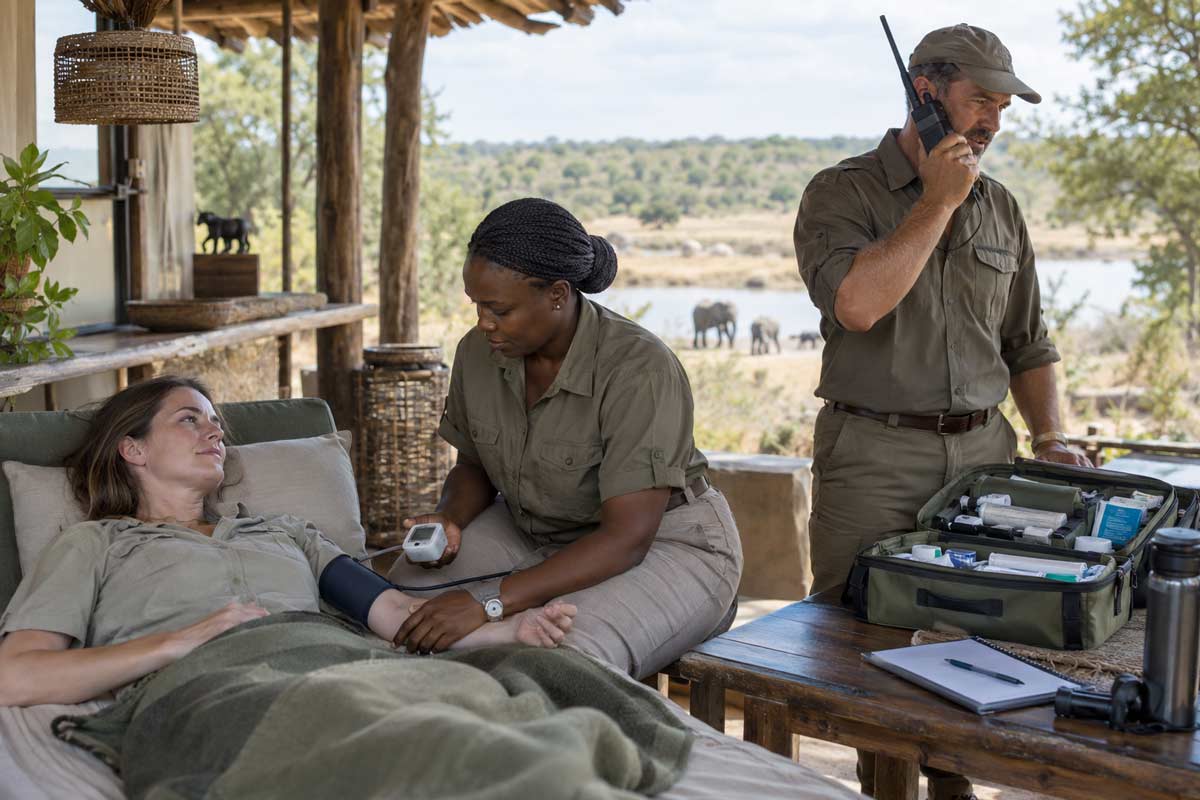
The first person to assist will usually be a guide, lodge manager or trained staff member. Depending on the property and country, the lodge may have first-aid equipment, trained personnel, a relationship with a local doctor or access to remote medical advice.
Staff may:
- Move the traveler to a safe and accessible location
- Provide first aid within their level of training
- Contact a doctor or medical assistance provider
- Gather information about symptoms and medical history
- Contact the lodge’s emergency transport provider
- Prepare for a vehicle, boat or aircraft transfer
- Inform the traveler’s tour operator
- Help establish communication with the insurer
This first response can be extremely valuable, but a lodge is not a hospital. Staff may support and stabilize a traveler while professional assistance is arranged, but they cannot replace a qualified clinical assessment or advanced medical treatment.
Travelers should ask about emergency procedures before booking a particularly remote property. The lodge or tour operator should be able to explain how staff communicate, which medical facilities are normally used and how a seriously ill guest would be transferred.
Emergency Medical Help on an African Safari
What Happens When You Activate TravelSafe SOS?
When an SOS alert is successfully transmitted, the TravelSafe SOS control center receives the available alert, location and registered account information. An operator attempts to contact the traveler and establish what has happened.
If the traveler can speak, the operator may ask about:
- The symptoms or injury
- The traveler’s present condition
- Their exact or available location
- Whether lodge staff are present
- What assistance has already been provided
- Relevant medical conditions and medication
- Insurance and travel details
- The safest way to maintain communication
The operator can then help identify an appropriate response pathway. Depending on the situation, this may involve contacting lodge staff, a medical provider, an ambulance or evacuation service, the traveler’s insurer, nominated next of kin or the registered travel agent.
TravelSafe SOS does not provide the physical medical treatment and does not replace the lodge’s emergency procedures. Its role is to help connect the incident, the traveler’s location and the relevant response organizations through a 24-hour coordination point.
Internal link for Mark: Add a forward link to Article 8, “How the TravelSafe SOS Control Centre Responds to an Emergency,” once published.
What If the Traveler Cannot Speak?
A traveler may be unconscious, confused, seriously short of breath or otherwise unable to explain what is happening. In these circumstances, the information entered before travel becomes particularly important.
If an SOS alert has been transmitted, the control center can use the available registered profile and location information to begin investigating the incident. The operator may attempt to contact:
- The traveler’s mobile phone
- A nominated next of kin
- The registered travel agent
- The lodge or accommodation provider
- A known travel companion
- An appropriate local responder
The available response will depend on the accuracy of the traveler’s profile, the information held by the service and the ability to establish communication with people near the traveler.
Travelers should therefore register before departure and ensure that their profile includes current personal information, medical conditions, allergies, medication, insurance details and emergency contacts. Telephone numbers should include international dialing codes.
A travel companion should also know how to activate the app on the traveler’s behalf. Waiting until someone becomes unconscious to locate policy documents, search for emergency numbers or determine which lodge they are staying at creates unnecessary delay.
How Is the Traveler’s Location Confirmed?
The lodge name is important, but it may not provide the traveler’s exact location. The person could be on a game drive, walking safari, boat excursion, beach, island transfer or road journey when the illness becomes critical.
Available GPS information can help identify where the alert originated. Lodge staff, guides and travel companions can provide additional operational information, including the nearest road, airstrip, jetty or accessible meeting point.
TravelSafe SOS Location Sharing
Accurate location information does not guarantee an immediate response. Distance, weather, road conditions, darkness, aircraft availability, medical capacity and connectivity can all affect what happens next. However, establishing a usable location quickly can reduce time lost trying to determine where assistance is needed.
Who Decides Whether You Need Evacuation?
Evacuation should be based on a professional assessment of the traveler’s condition and the treatment available locally. The nearest clinic may be able to provide initial care but may not be equipped to manage major trauma, cardiac emergencies, stroke, serious infection or another complex condition.
A medical professional may recommend:
- Treatment and monitoring at the lodge
- Transport to a nearby clinic
- Ground transfer to a regional hospital
- Transfer by boat or light aircraft
- A specialist medical evacuation
- Onward transfer to a larger medical center
The decision can change if the traveler’s condition deteriorates or if the first facility cannot provide the necessary care.
TravelSafe SOS can help coordinate communication between the lodge, medical professionals, transport providers and insurer. It does not make the final clinical decision, operate the ambulance or aircraft, or guarantee that evacuation will be immediately available.
Official travel guidance advises travelers to confirm that their destination can provide the healthcare they may need and to obtain insurance covering local treatment and unexpected medical evacuation.
UK Government South Africa Health Advice
Travel Insurance and Emergency Assistance
How Is a Medical Transfer Arranged?
Once a qualified medical professional determines that the traveler requires treatment elsewhere, the response team must identify the safest and most appropriate method of transfer.
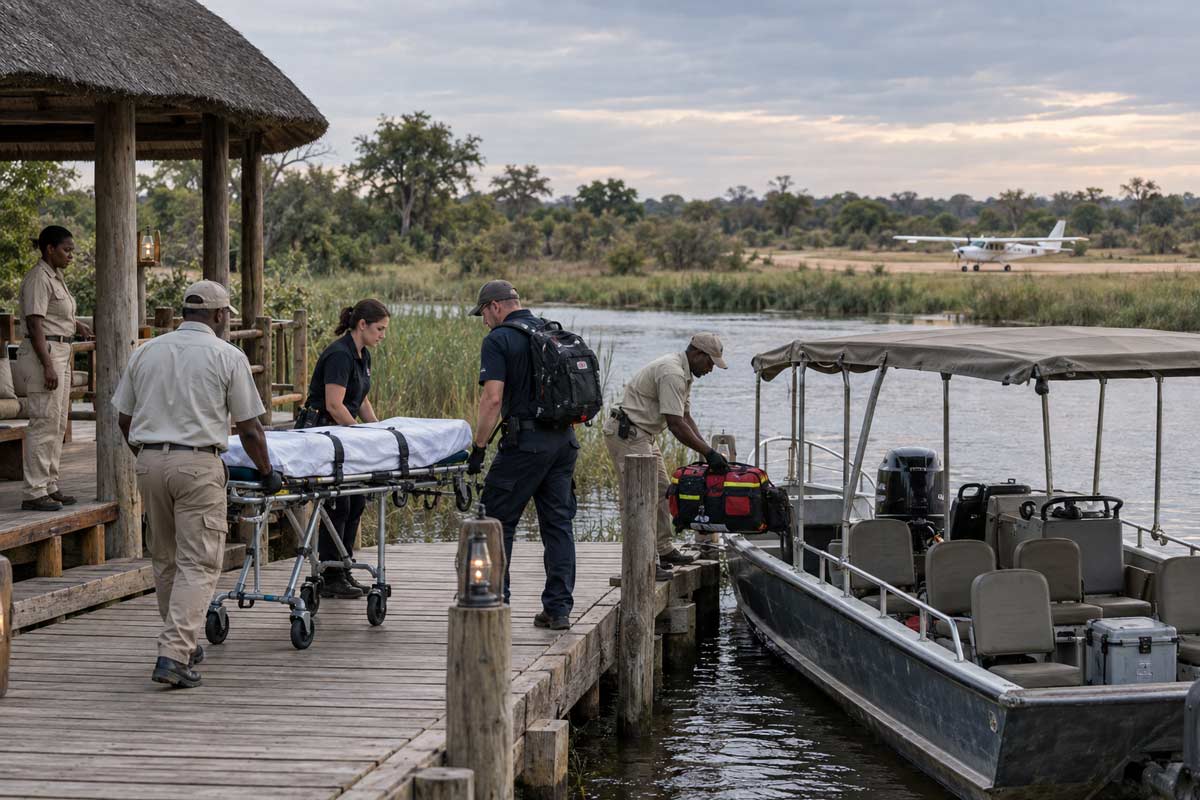
This may involve moving the traveler by road, boat or light aircraft before a specialist ambulance or medical evacuation provider can take over. At some remote lodges, the first stage may simply be transporting the traveler from their room to a vehicle, jetty or airstrip.
The transfer plan may require coordination between:
- Lodge staff and guides
- A doctor or medical assistance provider
- A road ambulance or local transport provider
- A boat or light-aircraft operator
- A specialist medical evacuation company
- The receiving clinic or hospital
- The traveler’s insurer
- The tour operator or travel agent
- Nominated next of kin
Each party needs accurate information. The transport provider must know where the traveler can be collected. The receiving facility must understand the medical condition and confirm whether it can provide appropriate care. The insurer may require a medical report, treatment plan or cost estimate before authorizing eligible expenses.
TravelSafe SOS can help establish communication between the relevant parties and support the coordination process. The service does not own or operate every ambulance, aircraft, boat or medical facility that may be involved.
What Can Delay Medical Assistance?
Emergency response in a remote destination is affected by practical conditions that may not exist in a city. Even when everyone acts promptly, assistance may take time to reach the traveler.
Possible causes of delay include:
- Weak mobile reception or internet connectivity
- Difficulty confirming the traveler’s exact location
- Long distances from medical facilities
- Poor road conditions
- Flooding or seasonal access restrictions
- Darkness or airstrip operating limitations
- Bad weather or reduced visibility
- Aircraft, ambulance or medical-crew availability
- Limited capacity at the nearest suitable hospital
- The need for insurer authorization or a payment guarantee
- Passport, medical or policy information that is unavailable
- A traveler who is unable to explain their condition
These limitations make early action essential. Waiting until symptoms become critical may reduce the available transport options or allow a manageable condition to become more difficult to treat.
TravelSafe SOS cannot remove distance, weather or operational restrictions. Its value lies in helping to activate a coordinated response promptly, using the traveler’s available location and registered information to reduce avoidable communication delays.
What Role Does Travel Insurance Play?
Comprehensive travel insurance is essential when visiting remote parts of Africa. Medical consultation, ambulance transport, hospitalization, specialist care, evacuation and repatriation can be expensive.
A suitable policy may cover eligible costs, subject to its terms, limits, exclusions and authorization requirements. Travelers should confirm that their policy covers every country, property and activity included in the itinerary.
Important questions to ask before departure include:
- Does the policy cover treatment at private medical facilities?
- Is emergency evacuation from a remote lodge included?
- What is the maximum medical and evacuation benefit?
- Is transfer limited to the nearest appropriate facility?
- Is onward evacuation to another country covered when medically necessary?
- Must the insurer authorize transport or treatment in advance?
- What happens when urgent treatment cannot wait?
- Are declared pre-existing medical conditions covered?
- Are safari, boating, diving, hiking and other planned activities included?
- Will the insurer pay the provider directly, or must the traveler pay first?
TravelSafe SOS does not provide travel insurance and does not pay for medical treatment, transport, evacuation or repatriation. The insurer remains responsible for all decisions concerning cover, authorization, claims and payment.
The two services perform different but complementary roles. Travel insurance may provide financial protection for eligible expenses. TravelSafe SOS helps the traveler activate and coordinate the immediate emergency response.
Travel Insurance and Emergency Assistance
Who Pays Before Insurance Approval?
Payment arrangements vary between countries, providers and insurance policies. An ambulance, doctor, hospital, aircraft operator or evacuation company may require a guarantee of payment before accepting or dispatching a service.
The guarantee may come from:
- The traveler’s insurer or assistance company
- The traveler or traveling companion
- A credit-card authorization
- An employer or membership program
- A tour operator, subject to its own terms
- Another responsible party
In a life-threatening emergency, immediate care may begin before every financial issue has been resolved. However, travelers should not assume that every provider will dispatch an aircraft, accept a hospital admission or begin non-urgent treatment without confirmation of payment.
Travelers should carry an accessible payment method for unexpected expenses. They should also understand whether the policy provides direct settlement or requires them to pay and submit a claim later.
TravelSafe SOS can assist with communication when the necessary insurance information is available, but it cannot approve a claim or guarantee that an insurer will accept a particular expense.
What Happens If There Is No Mobile Signal?
An app-based SOS alert requires suitable connectivity to reach the control center. A phone may be able to determine its location using GPS without mobile data, but the alert and location information still need a connection to be transmitted.
Remote lodge travelers should never rely on one communication method. Before arrival, ask the lodge or travel agent:
- Whether mobile reception or Wi-Fi is normally available
- Whether guides carry radios or satellite communication equipment
- How staff contact medical providers
- What happens during an emergency away from the lodge
- Whether communication systems operate throughout the night
- Where the nearest road, jetty or usable airstrip is located
- How a guest would be transferred if conditions prevented flying
If the app cannot transmit an alert, tell lodge staff immediately and use the fastest available alternative. This may involve a guide’s radio, the lodge telephone, a satellite device or the property’s established emergency channel.
TravelSafe SOS should be part of a broader emergency plan for remote travel. It does not replace the lodge’s communication equipment or a satellite device where the itinerary includes extended periods without mobile or internet coverage.
How Are Family Members and Travel Agents Informed?
A serious medical emergency can create anxiety and confusion for people at home. Family members may receive partial information, while the travel agent may understand the itinerary but not the traveler’s current medical condition.
Depending on the traveler’s registered instructions, the circumstances of the incident and applicable privacy procedures, the TravelSafe SOS control center may notify nominated next of kin and inform the registered travel agent.
The travel agent may be able to assist with practical matters such as:
- Confirming the itinerary and lodge details
- Contacting the accommodation or ground operator
- Rearranging flights and transfers
- Extending or canceling accommodation
- Assisting a traveling companion
- Providing documents held on the booking record
- Supporting communication with family members
The travel agent does not make clinical decisions or determine insurance cover. The insurer, medical professionals and local responders retain their respective responsibilities.
Travelers should nominate the correct emergency contacts and ensure that those people know they have been selected. Telephone numbers must include international dialing codes, and all information should be reviewed before each trip.
What Should You Prepare Before Staying at a Remote Lodge?
Preparation should be completed before leaving home, not after the traveler becomes ill.
Download and register TravelSafe SOS, enable the required location and calling permissions, and complete the emergency profile. Information should include:
- Full name and date of birth
- Current medical conditions
- Serious allergies
- Prescription medication
- Insurer and policy details
- The insurer’s 24-hour assistance number
- Nominated next of kin
- Registered travel-agent details
- Lodge and itinerary information
Essential medication should remain in hand luggage during flights and transfers. Travelers should carry enough medication for the trip, together with a reasonable contingency supply where medically appropriate.
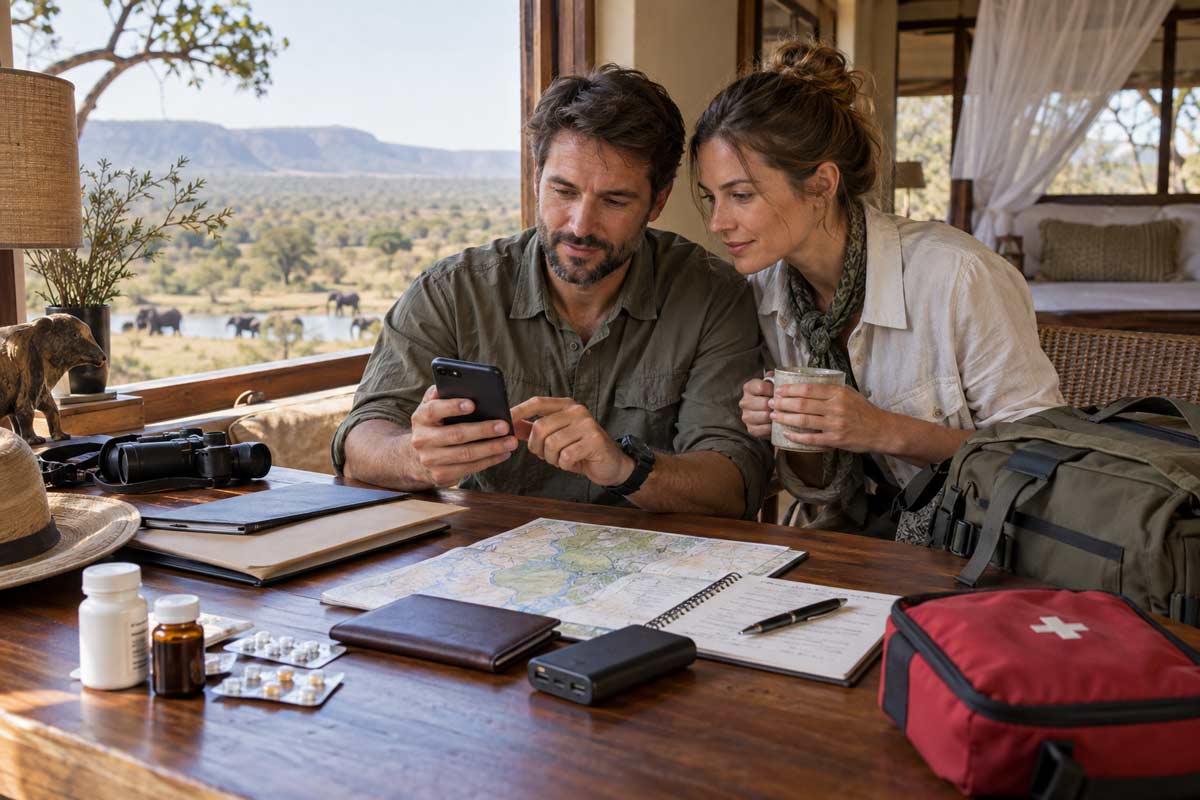
A travel companion should know where the medication, insurance documents and emergency information are stored. They should also understand how to activate the SOS function if the registered traveler cannot do so personally.
Before booking a remote lodge, travelers with significant medical conditions should discuss the itinerary with their treating doctor, insurer and travel specialist. They should ask whether the destination is appropriate for their needs and how quickly suitable medical care could realistically be reached.
Prepare Before You Need Emergency Help
Remote lodges offer access to some of Africa’s most rewarding wildlife, coastal and wilderness experiences. Their isolation is part of their appeal, but it also changes how a medical emergency must be managed.
The first response usually begins with lodge staff. Medical professionals assess the traveler’s condition. Transport and evacuation providers move the traveler where necessary. The insurer determines whether eligible costs will be covered.
TravelSafe SOS adds a 24-hour emergency coordination layer. When an alert is successfully transmitted, the control center can attempt to contact the traveler, use the available location and profile information, and begin coordinating an appropriate response.
Download and register TravelSafe SOS before traveling. Complete your medical, insurance and emergency-contact information while you are well enough to do so accurately. If you later become too ill to manage the emergency yourself, that preparation may help other people respond more effectively.