
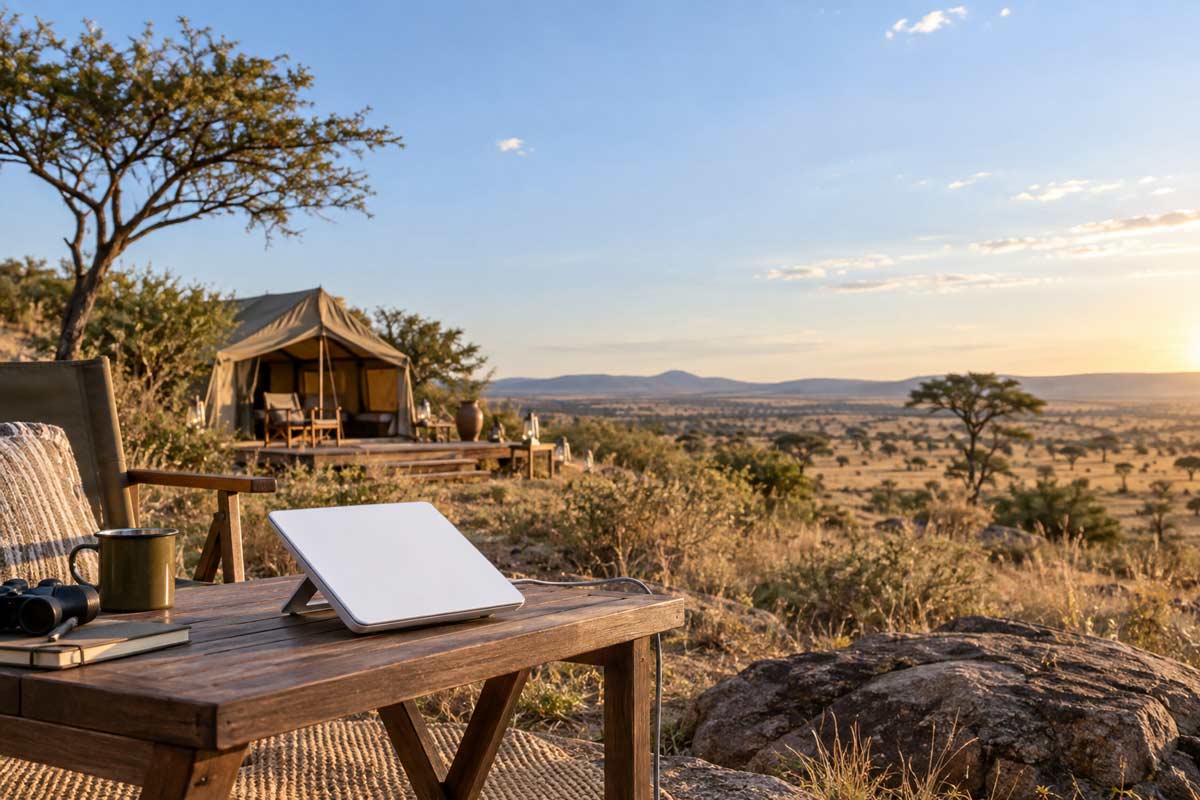
Starlink can provide internet access in some remote African destinations where ordinary mobile coverage is weak or unavailable. For travellers visiting isolated safari camps, national parks or self-drive regions, this could create an important additional communication option during a medical or security emergency.
However, Starlink does not automatically give every traveller continuous mobile coverage. A standard mobile phone does not connect directly to a conventional Starlink satellite service. The traveller needs access to a compatible Starlink terminal, an active service plan, electrical power and a sufficiently clear view of the sky. The phone then connects to the terminal through Wi-Fi.
If that connection is working, the traveller may be able to use internet-based services even when the local mobile network is unavailable. This could allow a TravelSafe SOS alert to transmit to the control centre, together with the available location and registered traveller information.
This is a significant development for African travel, but it must be understood realistically. Starlink can reduce a communications gap. It cannot guarantee uninterrupted connectivity, immediate responder arrival or emergency access in every location.
Why Remote Connectivity Matters During an Emergency
Mobile coverage across Africa has improved considerably, particularly in cities, towns and established tourism corridors. Travellers can still encounter inconsistent or absent coverage in remote regions of Kenya, Tanzania, Botswana and Namibia.
These gaps are not necessarily evidence that a destination is unsafe. Many occur precisely because travellers are visiting sparsely populated wilderness areas far from conventional infrastructure.
The problem is that a minor incident can become more serious when the traveller cannot communicate. A road accident, sudden illness, vehicle fire or security threat requires more than a GPS position displayed on a phone. Somebody must receive that position, understand what has happened and begin coordinating appropriate assistance.
A functioning satellite internet connection may allow the traveller to contact the TravelSafe SOS control centre when ordinary mobile data is unavailable. It may also support communication with the accommodation, rental company, insurer, travel agent or family.
Satellite connectivity cannot reduce the physical distance between an incident and the nearest responder. It can, however, reduce the time lost before the emergency is reported and assessed.
Starlink Is Not the Same as a Satellite Phone
This distinction must be clear before a traveller relies on Starlink.
A satellite phone communicates directly with a satellite network using a dedicated handset and service. A conventional Starlink system uses a separate terminal to establish an internet connection. Phones, tablets or computers then connect to that terminal by Wi-Fi.
For most travellers, this means carrying or accessing:
- A compatible Starlink terminal
- An active and suitable service plan
- A dependable power source
- A phone containing the TravelSafe SOS app
- Charging equipment and backup power
- A location with adequate sky visibility
- Equipment that has been activated and tested
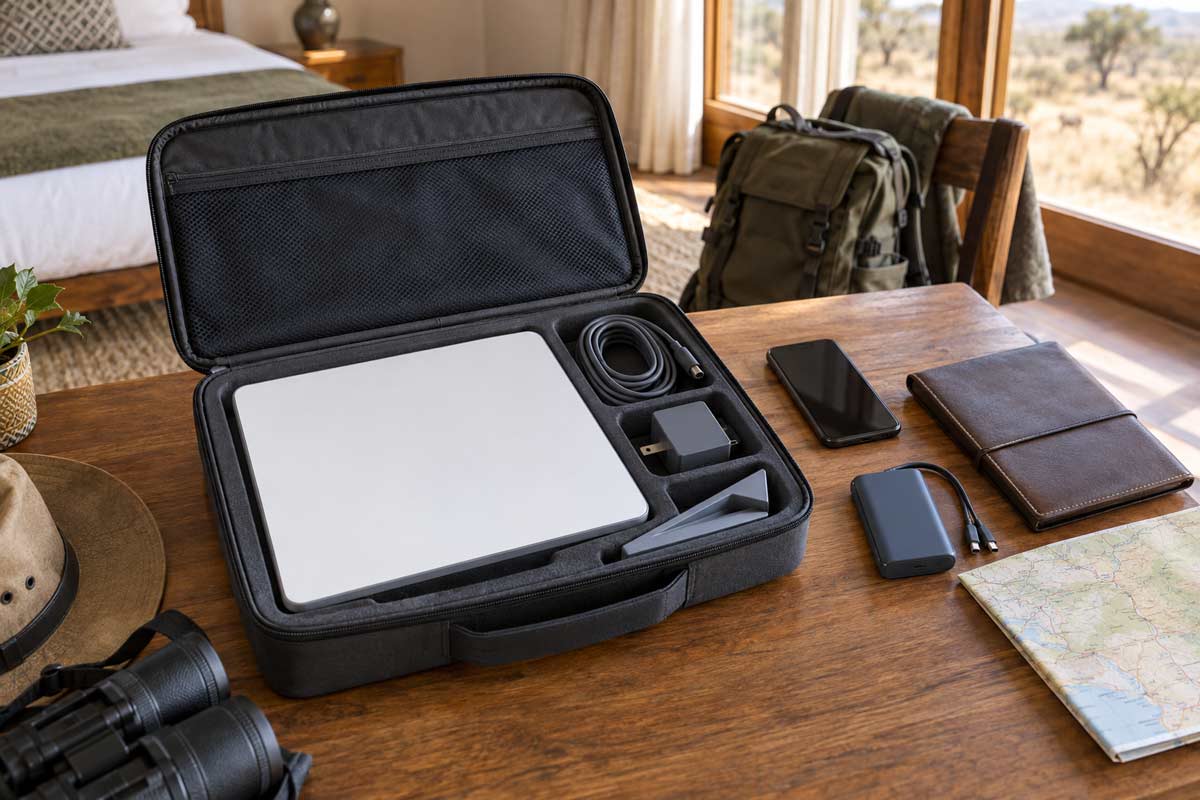
The portable Starlink Mini may be more practical than a larger residential terminal for certain travellers, guides and mobile safari operators. Its suitability still depends on the journey, local regulations, service plan and available power.
Travellers should never carry an unfamiliar terminal into a remote area and assume it will work. The equipment should be activated, updated, connected and tested before departure.

Does Starlink Provide 24-Hour Emergency Connectivity?
Starlink may provide internet access at any time of day when the equipment, account and surrounding conditions allow it. That is different from guaranteeing a permanent connection throughout a journey.
Performance may be affected by trees, mountains, steep valleys, buildings, power failure, damaged equipment, account restrictions, severe weather or an obstructed view of the sky. The terminal may need to be unpacked, powered and correctly positioned before a connection can be established.
Some services and equipment configurations may support use while a vehicle is moving, but travellers must not assume that every terminal or plan permits this. In many travel situations, the safer and more realistic procedure will be to stop in a suitable location and establish the connection.
Starlink should therefore form one part of a layered communication plan. Local mobile data remains useful where coverage exists. Offline maps, saved emergency contacts, monitored itineraries and satellite communication may provide additional protection where the route justifies them.
How Could Starlink Support TravelSafe SOS?
When ordinary mobile data is unavailable, the traveller could connect the phone to an authorized and functioning Starlink Wi-Fi network. Once an internet connection has been established, a TravelSafe SOS alert may be able to transmit to the control centre.
The emergency pathway is straightforward:
- The traveller connects the phone to Starlink Wi-Fi.
- The TravelSafe SOS alert is activated.
- The transmitted alert reaches the control centre.
- An operator attempts to contact the traveller.
- The incident and available location information are assessed.
- An appropriate available emergency response is coordinated.
- Relevant registered contacts can be notified according to current procedures.
Depending on the emergency, coordination may involve police, emergency medical services, private medical providers, fire or rescue services, park authorities, the accommodation, tour operator, rental company or insurer. The registered travel agent and nominated next of kin may also be informed.
TravelSafe SOS does not control the Starlink connection and cannot receive an alert that has not transmitted successfully. Starlink does not assess the emergency or arrange the response. The two services perform completely different but potentially complementary functions.
Can International Travellers Simply Bring Starlink to Africa?
Not necessarily.
Satellite coverage overhead does not mean that a service is licensed, activated or legally available in every country. Equipment importation, account registration, international roaming, service-plan limitations and local telecommunications regulations must all be checked.
Kenya provides the clearest example among the four countries considered in this article. Starlink is licensed and operating, and Kenya’s communications regulator has recorded both Starlink subscriptions and a local equipment-rental initiative. This may create practical options for residents, businesses and some travel operators. Communications Authority of Kenya
Botswana has also authorized Starlink operations, making satellite internet increasingly relevant to remote safari camps, mobile operators and self-drive travellers. Current equipment, rental and traveller-access options must still be confirmed before departure.
Namibia and Tanzania require greater caution. Travellers should not import or activate equipment based only on an online coverage map or a subscription purchased in another country. The regulatory and service position must be checked immediately before travel.
The safest approach is to confirm whether a lodge, safari operator, specialist rental company or authorized local provider already offers Starlink access. Travellers planning to bring their own equipment must verify the destination country, service plan, roaming permission, customs requirements and tended route directly with the relevant authorities and Starlink before departure.
Where Could Starlink Help Travellers in Africa?
The practical value of Starlink depends on the destination, local authorization and the type of journey.
In Kenya, satellite internet could support remote conservancies, mobile safari camps, isolated lodges and long road journeys through regions where ordinary mobile coverage is inconsistent. Kenya’s Communications Authority continues to list Starlink Internet Services Kenya as a licensed operator. It has also reported substantial growth in satellite internet subscriptions and the introduction of an equipment-rental option.
Check Kenya’s current licensed telecommunications providers
In Botswana, the technology is relevant to the Okavango Delta, Central Kalahari, Makgadikgadi and isolated self-drive routes. A safari camp may already use Starlink operationally, but this does not automatically mean guests can depend on continuous access. Travellers should ask whether guest Wi-Fi remains available during an emergency, including outside normal service hours.
Namibia demonstrates why regulatory checks are essential. In March 2026, Starlink reported that its application to operate in Namibia had not been approved. Travellers should therefore not assume that equipment purchased or registered elsewhere may be legally imported and used in the country.
Read Starlink’s current Namibia regulatory update
Tanzania also requires confirmation immediately before travel. Travellers should check the current position with the Tanzania Communications Regulatory Authority and Starlink rather than relying on unofficial sellers or an online coverage map. The same regulatory position generally applies when visiting Zanzibar, which is part of the United Republic of Tanzania.
How Can a Traveller Obtain Starlink?
The simplest option may be to use equipment supplied by an established lodge, safari operator, mobile camp or vehicle-rental company. This avoids some of the complications associated with purchasing equipment internationally, importing it and activating it in another country.
Before relying on operator-provided Starlink, ask:
- Is the equipment licensed and active in the destination?
- Will guests be permitted to use it during an emergency?
- Is it installed permanently or carried in a vehicle?
- Does it operate throughout the itinerary or only at the lodge?
- Is backup power available?
- Who knows how to set it up?
- Can a traveller connect a personal phone containing TravelSafe SOS?
- What alternative communication is available if Starlink fails?
Purchasing or renting a Starlink Mini may be practical for some travellers, guides and expedition operators. However, the equipment must be obtained through an authorized channel and paired with a plan that permits the intended use.
International visitors must check whether the plan supports travel outside its registered country. Starlink’s international travel arrangements are changing during 2026. Global Roam is being discontinued, and current Roam products have specific country, time and registration conditions. A plan purchased in the United States, United Kingdom or Europe should never be assumed to work automatically in every African destination.
Check the current Starlink Roam options
Can You Carry a Starlink Terminal on a Flight?
A portable terminal may be carried internationally, but the traveller must confirm airline, battery, customs and destination-country requirements before departure.
The terminal itself and any separate power bank should be considered individually. Airlines commonly impose restrictions on the capacity, packaging and placement of lithium batteries. Large batteries may require prior approval or may not be accepted.
Legal operation is a separate issue from airline carriage. Being permitted to take a terminal onto an aircraft does not mean the traveller is permitted to import, activate or operate it after arrival.
Keep proof of purchase, equipment details and service information available. If customs or regulatory permission is unclear, obtain written guidance before travelling rather than depending on informal online advice.

What Power and Setup Does Starlink Require?
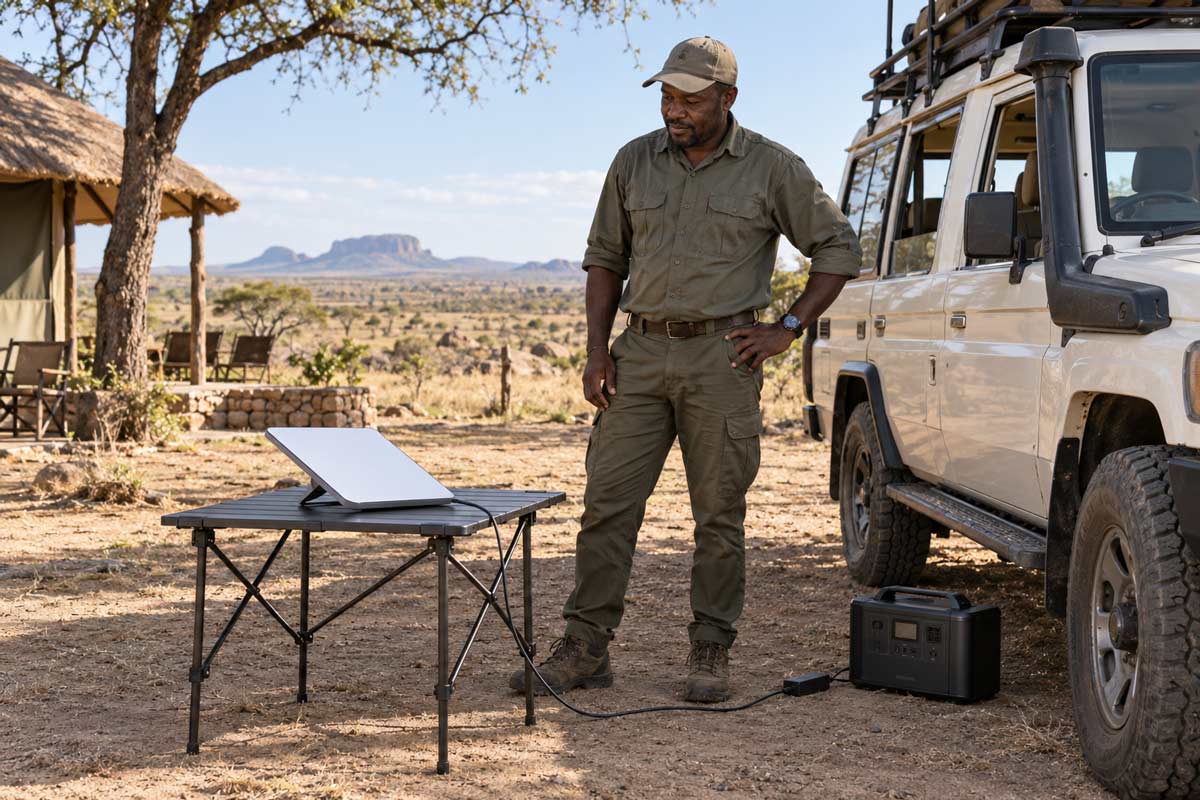
A Starlink terminal requires continuous electrical power while it is operating. Depending on the equipment and installation, that power may come from a vehicle, portable power station, lodge supply or another approved source.
Travellers should test the complete setup before entering a remote region. This includes the terminal, cables, adapters, battery, phone connection and TravelSafe SOS app. A terminal without the correct cable or sufficient power has no emergency value.
The equipment also needs a suitable view of the sky. Trees, buildings, rock faces and steep valleys can interrupt or prevent the connection. Starlink’s installation guidance specifically requires a clear view of the sky.
See the official Starlink Mini setup guidance
Do not position equipment where it creates a roadside hazard or exposes travellers to traffic, wildlife or another security risk. If the vehicle has stopped after an accident, personal safety and medical needs must take priority over achieving the ideal satellite position.
Can Starlink Be Used While Driving?
Travellers should not assume that every terminal, mounting system or service plan allows in-motion use.
A portable terminal placed loosely on a dashboard, roof or luggage rack can become dangerous during sudden braking or a collision. It may also be damaged by dust, water, vibration or theft.
For most independent travellers, the safer approach is to stop in an appropriate location, assess the surroundings and establish the connection while stationary. Any permanent vehicle installation should be professionally fitted and used in accordance with the equipment instructions, service plan, local law and rental-company conditions.
The driver must never attempt to position, configure or troubleshoot Starlink while controlling the vehicle.
What If Starlink Does Not Connect?
Starlink should strengthen an emergency plan, not become its single point of failure.
If the connection cannot be established, use the safest available alternative. This could include:
- Moving only when it is safe to seek a clearer view of the sky
- Trying ordinary mobile voice, SMS or data
- Using a tested satellite phone or satellite messenger
- Contacting the accommodation or guide by radio
- Seeking assistance from park authorities
- Asking another vehicle to relay an emergency message
- Following the agreed missed-arrival procedure
Conserve phone, terminal and battery power. Keep GPS coordinates, vehicle details, medical information, insurance contacts and emergency numbers available offline.
Do not walk alone for help from an isolated vehicle unless remaining there presents a greater danger and no safer communication option exists. A vehicle is usually easier for responders or passing traffic to identify than an individual on foot.
Starlink Does Not Guarantee an Immediate Response
Successfully reporting an emergency is only the first part of the response.
A remote safari camp, desert road or wilderness area may still be many hours from an ambulance, police station, medical facility or rescue team. Weather, road conditions, darkness, aircraft availability and the seriousness of the incident can all affect the response.
Starlink may help reduce the delay in communicating the emergency. TravelSafe SOS may then provide a defined coordination pathway, but neither service can guarantee responder availability or arrival time.
Travellers still need comprehensive travel insurance, appropriate medical evacuation cover and an itinerary suited to their health, experience and vehicle.
Register Before Entering a Remote Area
Do not wait until an emergency to download the app, create an account or search for insurance information.
Register for TravelSafe SOS before leaving home or before beginning the remote part of the journey. Complete the traveller profile with accurate medical information, insurer details, travel-agent information and nominated next of kin.
If travelling with a partner, family or group, make sure more than one person knows how to activate the SOS button. Test the available mobile and satellite connections before leaving the last reliable town, lodge or camp.